Skip to content
HardSteel CNCGet matched

Materials

Hard steel materials: families, grades and hardness

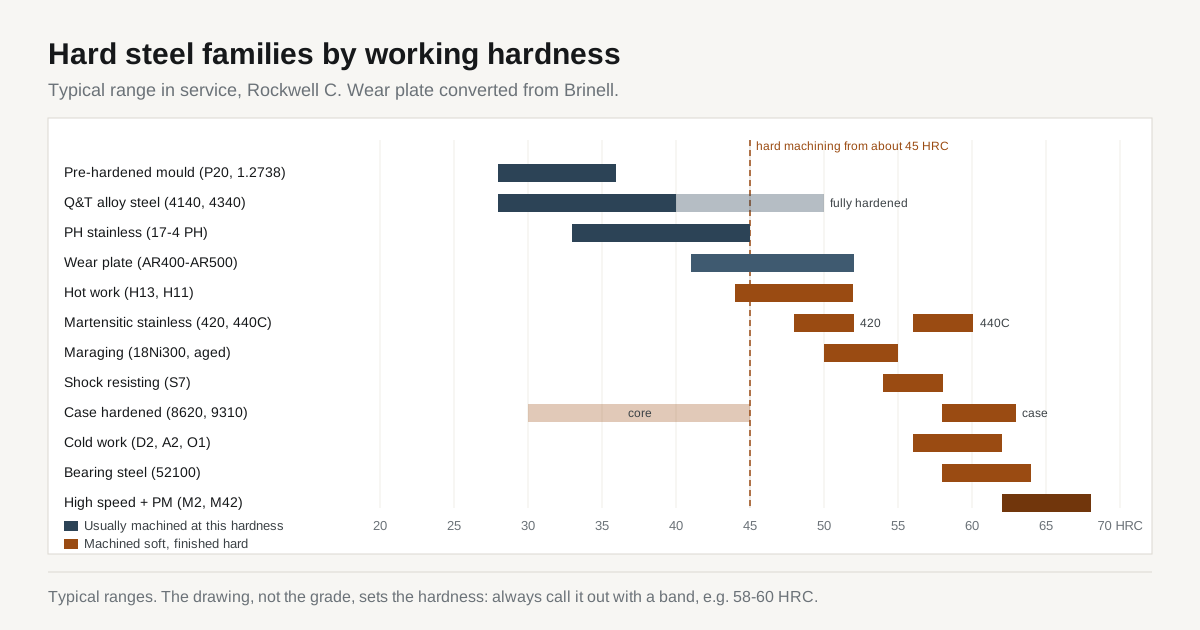
"Hard steel" covers 12 families that behave differently on the machine and in service. For each family: composition type, grades used on drawings and mill certificates, working hardness and finishing route.

The families at a glance

Designations: AISI first, then JIS and DIN Werkstoff number where common. Typical ranges.
FamilyWorking hardnessSupplied asFinished by
Cold work tool steel56-62 HRCAnnealed, about 210-255 HBGrinding, hard milling, wire EDM
Hot work tool steel44-52 HRCAnnealed, or pre-hardened blocks at 44-48 HRCHard milling (often in one setup), sinker EDM, polishing
Shock resisting tool steel54-58 HRCAnnealedGrinding, hard milling
High speed steel62-68 HRCAnnealed, about 230-270 HBGrinding, wire EDM
Powder metallurgy (PM) tool steel58-66 HRCAnnealedGrinding, wire EDM; hard milling only with care
Plastic mould steel28-36 HRC pre-hardened; 48-52 HRC for hardened 420Pre-hardened blocks (P20 types); annealed (420)Milling to size (pre-hardened); hard milling, EDM and polishing (420)
Quenched and tempered alloy steel28-40 HRC as supplied; up to about 50 HRC fully hardenedPre-hardened (4140 PH about 28-32 HRC) or annealedCarbide milling and turning; grinding when hardened
Case hardening steelCase 58-62 HRC over a 30-45 HRC coreAnnealed or normalisedHard turning and grinding of the case
Bearing steel58-64 HRCSpheroidise annealedHard turning, cylindrical grinding, honing
Martensitic stainless steel48-52 HRC (420) · 56-60 HRC (440C)AnnealedGrinding, hard milling, polishing
Precipitation hardening and maraging steel35-45 HRC (17-4 PH) · 50-55 HRC (18Ni300 aged)Solution treated, about 30-35 HRCMachined almost to size, then aged; light finishing after
Abrasion-resistant wear plate360-540 HB, roughly 38-52 HRCHardened at the mill, used as deliveredPlasma, laser or waterjet cutting; carbide drilling and countersinking

Grade-by-grade data (equivalents, machinability, quench medium, distortion):tool steel grade table.

Cold work tool steel

D2 (SKD11, 1.2379) · D3 (SKD1, 1.2080) · A2 (SKD12, 1.2363) · O1 (1.2510)

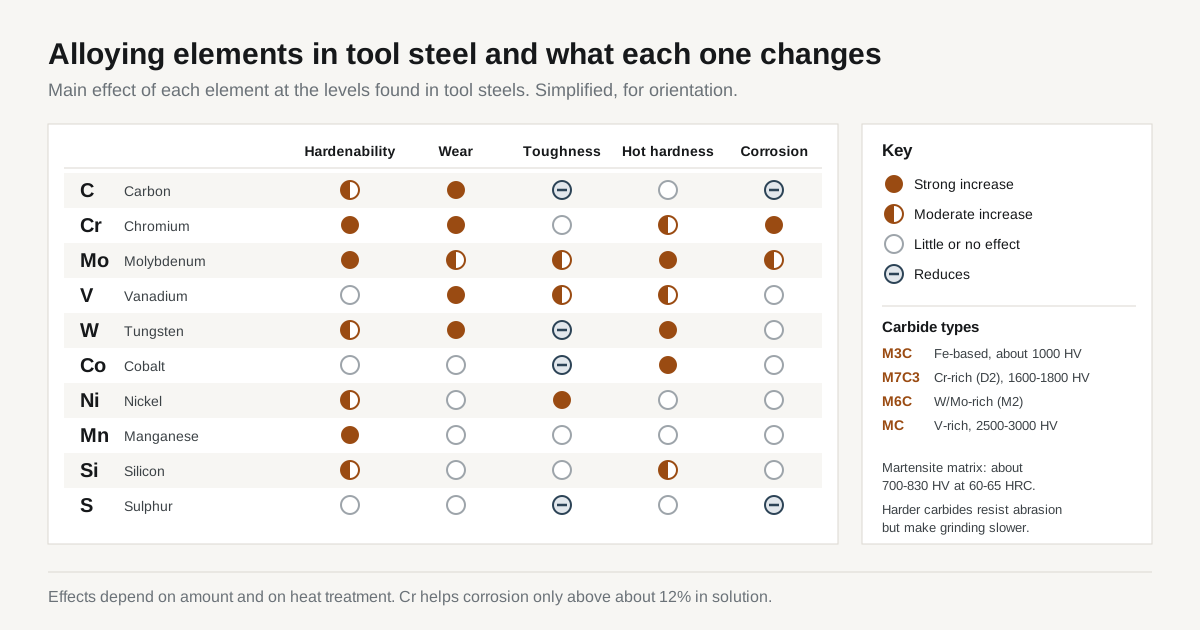
High-carbon, high-chromium steels for wear resistance at room temperature. D2 and D3 carry a large volume of chromium carbides. A2 gives up some wear resistance for toughness and very low distortion. O1 is the low-cost oil-hardening option.

Used for: Blanking and piercing punches and dies, forming tools, shear blades, thread rolls, gauges.

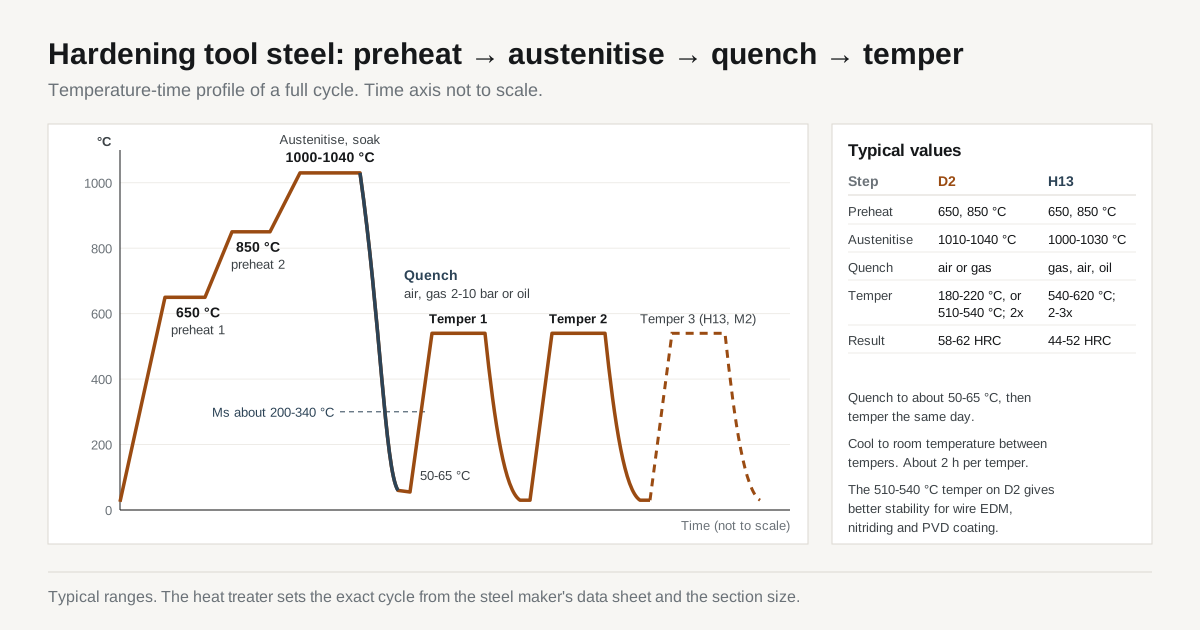
Watch for: D2 chips before it wears on heavy-impact jobs. For wire EDM work, specify the high-temperature temper (about 500-540 °C). Low-tempered D2 can crack when a large slug is cut out.

Working hardness
56-62 HRC
Supplied as
Annealed, about 210-255 HB
Finished by
Grinding, hard milling, wire EDM

Hot work tool steel

H13 (SKD61, 1.2344) · H11 (SKD6, 1.2343)

Medium-carbon Cr-Mo-V steels that keep their hardness at 500-600 °C and resist heat checking. Carbon is lower than in cold work steel. The result is higher toughness and easier hard milling.

Used for: Die casting dies, forging dies, extrusion tooling, hot stamping and high-volume plastic moulds.

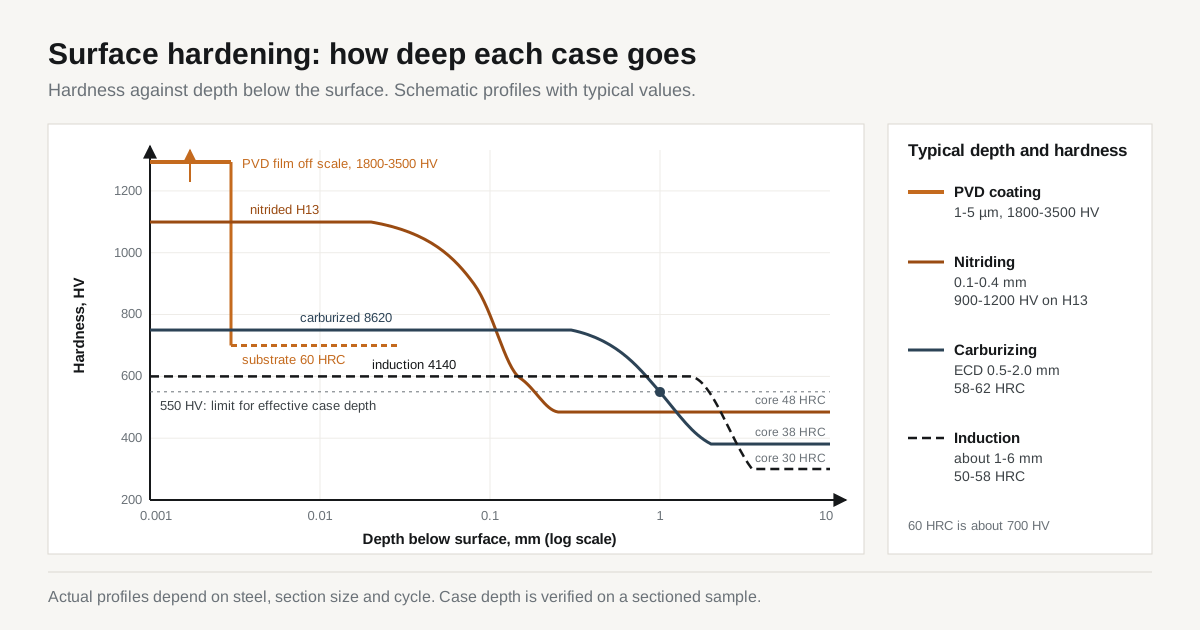
Watch for: Often nitrided after machining for wear resistance. Specify the nitriding depth and the surface hardness on the drawing.

Working hardness
44-52 HRC
Supplied as
Annealed, or pre-hardened blocks at 44-48 HRC
Finished by
Hard milling (often in one setup), sinker EDM, polishing

Shock resisting tool steel

S7 (1.2357 is the closest DIN grade)

Low-carbide steels designed for impact toughness instead of wear resistance. They take impact loads that crack D2.

Used for: Heavy punches, chisels, shear blades for thick plate, rivet sets, ejector parts that take impact.

Watch for: Wears faster than cold work steel under sliding abrasion. A tool that fails by wear, not by cracking, needs a different grade.

Working hardness
54-58 HRC
Supplied as
Annealed
Finished by
Grinding, hard milling

High speed steel

M2 (SKH51, 1.3343) · M35 (SKH55, 1.3243) · M42 (SKH59, 1.3247)

Tungsten-molybdenum steels with vanadium. M35 and M42 add cobalt. They keep their hardness at red heat. Originally a cutting tool material, now also used for punches in thin high-strength sheet.

Used for: Cutting tools, punches and buttons for high-strength sheet, cold forming tools, wear parts that need more than D2.

Watch for: Above about 64 HRC, hard milling is rarely economic. Plan grinding and EDM for the finished features.

Working hardness
62-68 HRC
Supplied as
Annealed, about 230-270 HB
Finished by
Grinding, wire EDM

Powder metallurgy (PM) tool steel

PM high-vanadium cold work (e.g. CPM 10V) · PM high speed (e.g. ASP 23)

Made from atomised powder. Carbides are small and evenly spread, without the coarse bands of ingot steel. Wear resistance and toughness are both higher. Price is about 2-4x conventional grades.

Used for: Long-run punches and dies, slitter knives, tooling for abrasive or high-strength materials.

Watch for: The vanadium carbide that gives the wear resistance also wears grinding wheels and cutters. Finishing times are longer.

Working hardness
58-66 HRC
Supplied as
Annealed
Finished by
Grinding, wire EDM; hard milling only with care

Plastic mould steel

P20 (1.2311) · P20+Ni (1.2738) · 420 ESR (1.2083, SUS420J2)

Steels selected for machinability, polishability and size stability in large blocks. Pre-hardened grades are machined to size with no furnace step.

Used for: Injection mould cavities, cores, inserts, mould plates; 420 for PVC, medical and optical parts that need corrosion resistance and a mirror finish.

Watch for: Pre-hardened P20 wears and dents in long runs or with glass-filled resins. The usual fix is a hardened insert in H13 or 420.

Working hardness
28-36 HRC pre-hardened; 48-52 HRC for hardened 420
Supplied as
Pre-hardened blocks (P20 types); annealed (420)
Finished by
Milling to size (pre-hardened); hard milling, EDM and polishing (420)

Quenched and tempered alloy steel

4140 (SCM440, 1.7225 / 42CrMo4) · 4340 (SNCM439, 1.6582 / 34CrNiMo6)

Medium-carbon Cr-Mo steels. They are not tool steels, but most holders, shafts and structural tooling parts use them. Through-hardenable in moderate sections and suited to induction hardening.

Used for: Die shoes, holders, fixture plates, shafts, gears, pins, induction-hardened wear surfaces.

Watch for: "4140" on a drawing without a hardness is incomplete. Annealed, pre-hardened and fully hardened 4140 are 3 different machining jobs.

Working hardness
28-40 HRC as supplied; up to about 50 HRC fully hardened
Supplied as
Pre-hardened (4140 PH about 28-32 HRC) or annealed
Finished by
Carbide milling and turning; grinding when hardened

Case hardening steel

8620 (SNCM220, 1.6523) · 9310 · 20MnCr5 (1.7147) · SCM415

Low-carbon steels for carburising. Carbon is diffused into the surface. After quenching only the outer 0.5-2 mm is hard and the core stays tough.

Used for: Gears; splined shafts; pins; cams; rollers. Parts that need a wear surface and impact strength together.

Watch for: Every 0.1 mm ground off the surface comes out of the case depth. Specify the effective case depth after grinding.

Working hardness
Case 58-62 HRC over a 30-45 HRC core
Supplied as
Annealed or normalised
Finished by
Hard turning and grinding of the case

Bearing steel

52100 (SUJ2, 1.3505 / 100Cr6, GCr15)

A clean high-carbon chromium steel with a fine, uniform carbide structure. Hardens fully in moderate sections. Takes a ground or turned finish down to Ra 0.2 µm.

Used for: Bearing races and rollers, guide pins and bushings, gauge pins, precision shafts.

Watch for: The most common grade for hard turning in place of grinding. Fatigue-loaded surfaces need a white layer check.

Working hardness
58-64 HRC
Supplied as
Spheroidise annealed
Finished by
Hard turning, cylindrical grinding, honing

Martensitic stainless steel

420 (SUS420J2, 1.4028) · 440C (SUS440C, 1.4125)

Stainless steels with enough carbon to harden like tool steel. Corrosion resistance is below 304 or 316. It also depends on the heat treatment.

Used for: Corrosion-resistant moulds, knives and blades, valve seats, pump parts, bearings in wet service.

Watch for: Tempering in the 425-550 °C range lowers corrosion resistance and toughness in these grades. The heat treat sheet should show the temper temperature.

Working hardness
48-52 HRC (420) · 56-60 HRC (440C)
Supplied as
Annealed
Finished by
Grinding, hard milling, polishing

Precipitation hardening and maraging steel

17-4 PH (SUS630, 1.4542) · 18Ni300 maraging (1.2709)

Steels hardened by ageing at about 480-620 °C instead of a quench. Without a quench there is almost no distortion. Size change is a small, predictable shrinkage.

Used for: Precision tooling and fixtures, aerospace and medical parts, conformal-cooled mould inserts (maraging is common in metal 3D printing).

Watch for: Maraging steel is expensive and not widely stocked. Confirm availability before the design is fixed.

Working hardness
35-45 HRC (17-4 PH) · 50-55 HRC (18Ni300 aged)
Supplied as
Solution treated, about 30-35 HRC
Finished by
Machined almost to size, then aged; light finishing after

Abrasion-resistant wear plate

AR400 · AR450 · AR500 (quenched and tempered plate)

Low-alloy plate, quenched and tempered at the mill. It is not heat treated again. Every hole, bevel and profile is cut at full hardness.

Used for: Chute and hopper liners, bucket edges, crusher and conveyor wear parts, skirt boards.

Watch for: Thermal cutting and welding soften the edge zone. Hole patterns close to a flame-cut edge can land in a softened band.

Working hardness
360-540 HB, roughly 38-52 HRC
Supplied as
Hardened at the mill, used as delivered
Finished by
Plasma, laser or waterjet cutting; carbide drilling and countersinking

Choosing

Grade selection by failure mode

The failure mode of the current part or the last tool is the most reliable input for grade selection.

Failure modeDirection
Abrasive wearMore carbide: O1 → A2 → D2 → PM high-vanadium
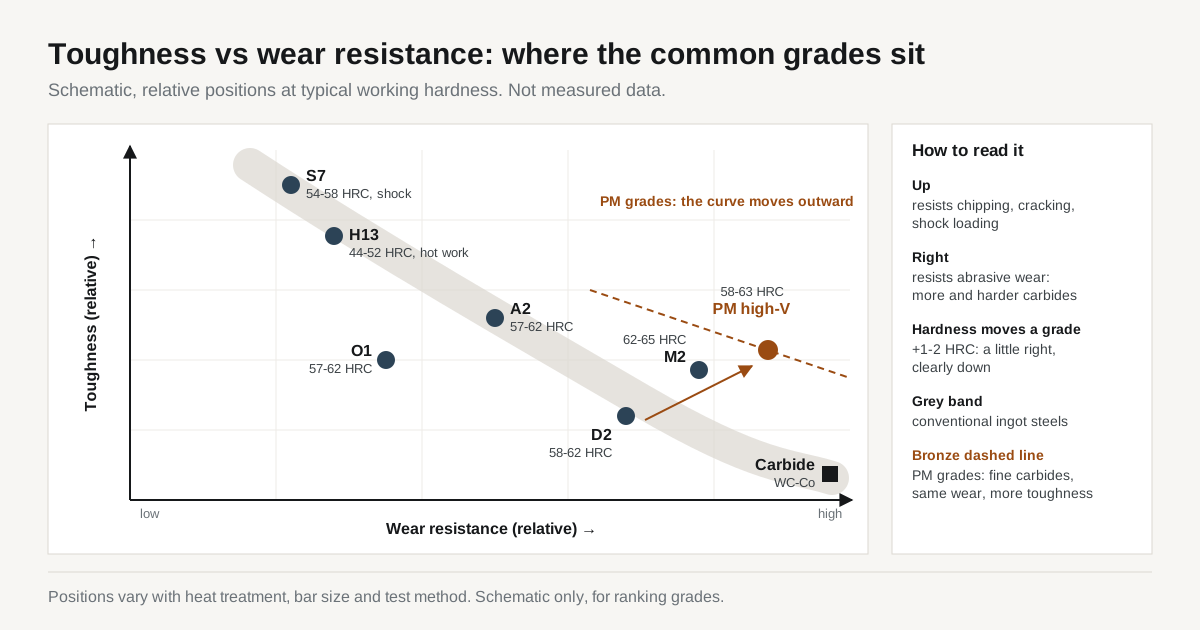
Edge chipping or crackingMore toughness: D2 → A2 → S7, or a PM grade at the same hardness
Heat checking at working temperatureHot work steel: H13, H11; consider nitriding
Corrosion or mirror polish requirement420 ESR, 440C
Hard surface with a tough coreCase hardening (8620, 20MnCr5) or induction-hardened 4140
Large part, low volume, distortion not acceptablePre-hardened P20 or 4140 PH, no furnace step

The reasoning behind this is intoughness vs wear resistance.

Common questions

Definition of hard steel?

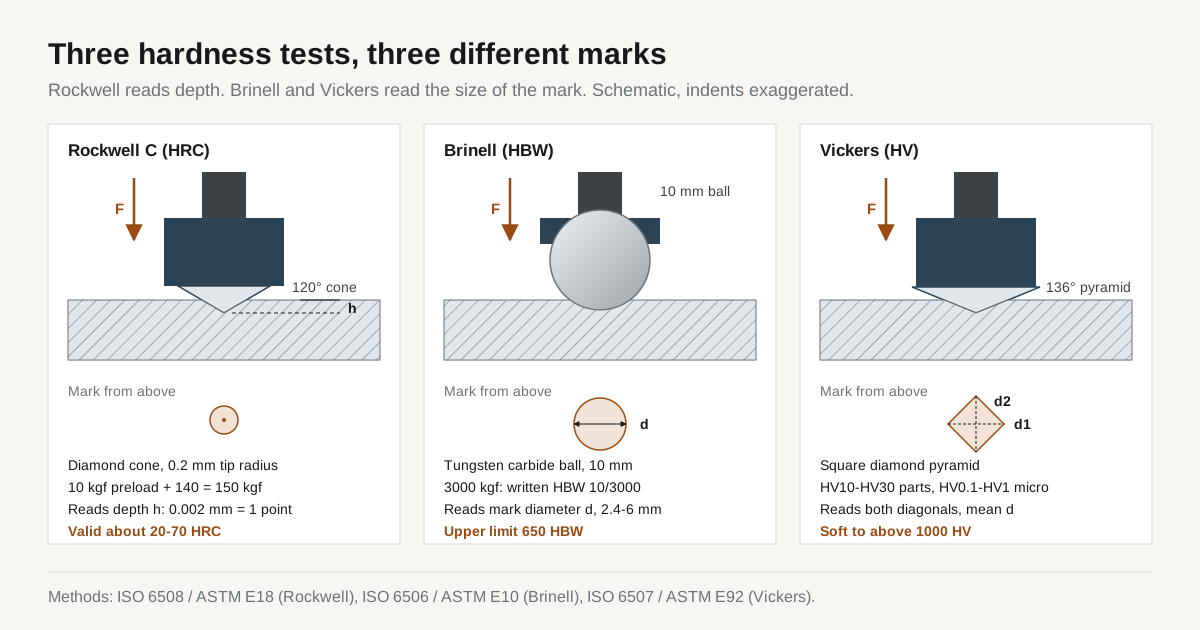
There is no standard definition. In machining, hard steel usually means steel cut or finished at about 45 HRC and above. That covers hardened tool steel, bearing steel, case-hardened parts, martensitic stainless and wear plate. Pre-hardened steel at 28-40 HRC is a border case: harder than structural steel, but still cut with carbide tools.

SKD11, D2 and 1.2379: same steel?

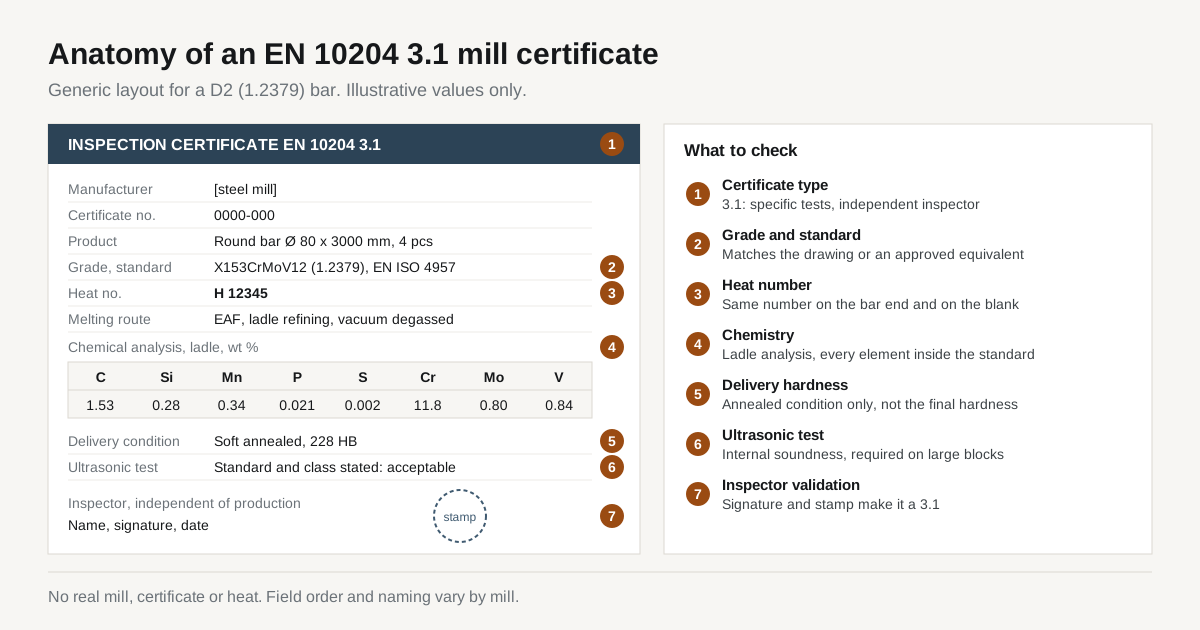
Close equivalents, not identical. SKD11 (JIS), D2 (AISI) and 1.2379 (DIN) have overlapping but different chemistry ranges, and quality varies by mill. They are often interchangeable on general tooling. On a critical part, the drawing should name the standard and the RFQ should ask for the mill certificate of the bar used.

Hardest steel that can be machined?

About 65-68 HRC with CBN tooling and grinding. High speed and PM steels sit at the top of that range. Wire EDM and sinker EDM are not limited by hardness at all, as long as the steel conducts electricity. Hard milling above about 64 HRC is possible but rarely economic, so grinding and EDM take over.

Higher hardness and wear resistance?

Not always linked. At the same hardness, a steel with more and harder carbides wears more slowly. D2 outwears 52100 at 60 HRC, and a PM high-vanadium grade outwears D2. Hardness, toughness and wear resistance are 3 separate properties. Grade choice depends on how the part fails in service.

Cutting these materials after hardening:machining processes for hardened steel.

RFQ for parts in these steels

Drawings with grade and hardness are matched with shops that already cut that material at that hardness. Written reply within 24 business hours.