Processes
Machining processes for hardened steel
Above about 45 HRC, standard carbide cutting stops working and a different set of processes takes over. Each page covers 1 process: mechanism, tolerance and finish, limits and the drawing notes that make quotes from different shops comparable.
All processes
 01
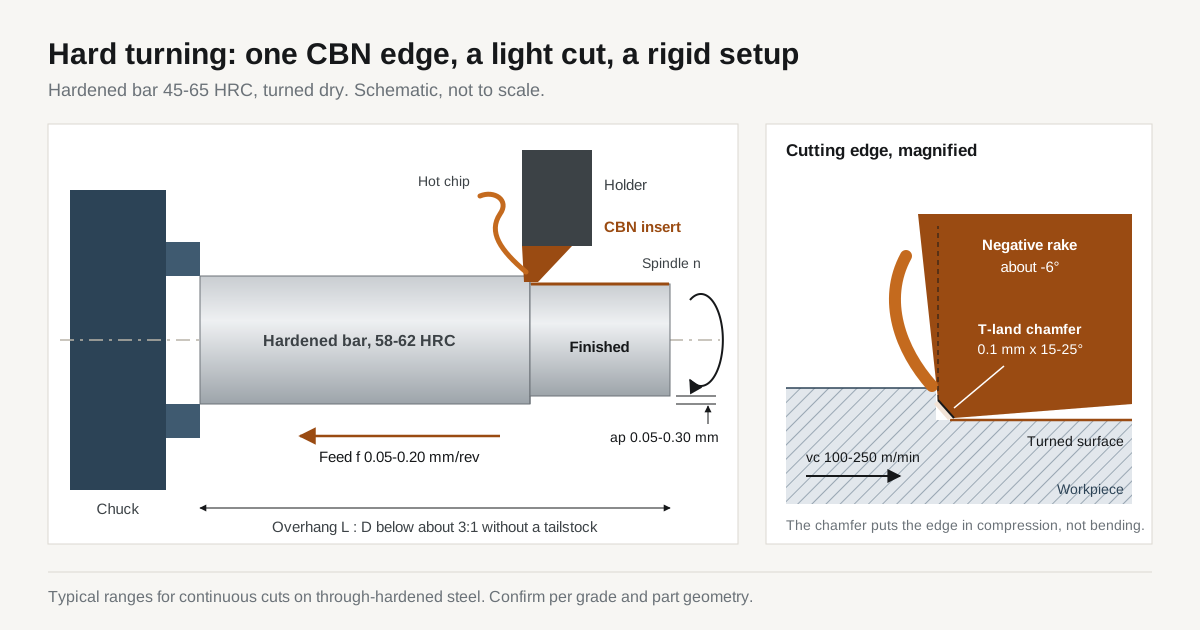
Hard turning
Turning through-hardened round parts with CBN. Replaces grinding on short, stiff parts and holds IT6 diameters at Ra 0.2-0.8 µm.
 02
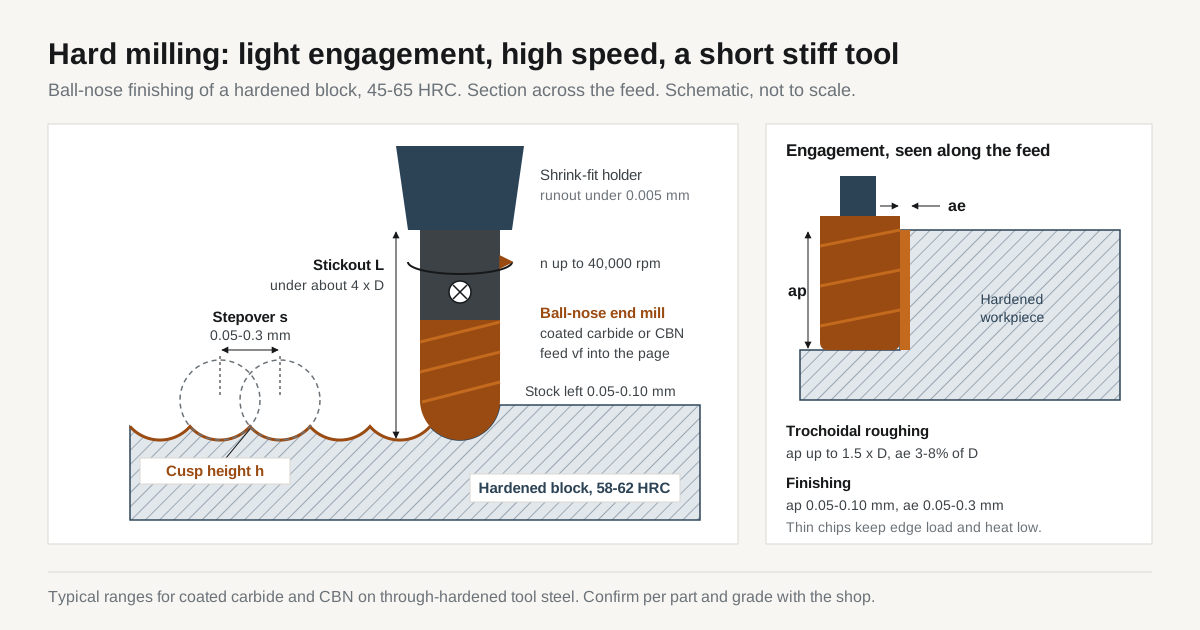
Hard milling
Finishing hardened steel on a machining centre with light, fast cuts. Typical ±0.01 mm, ±0.005 mm on called features, Ra 0.2-0.8 µm.
 03
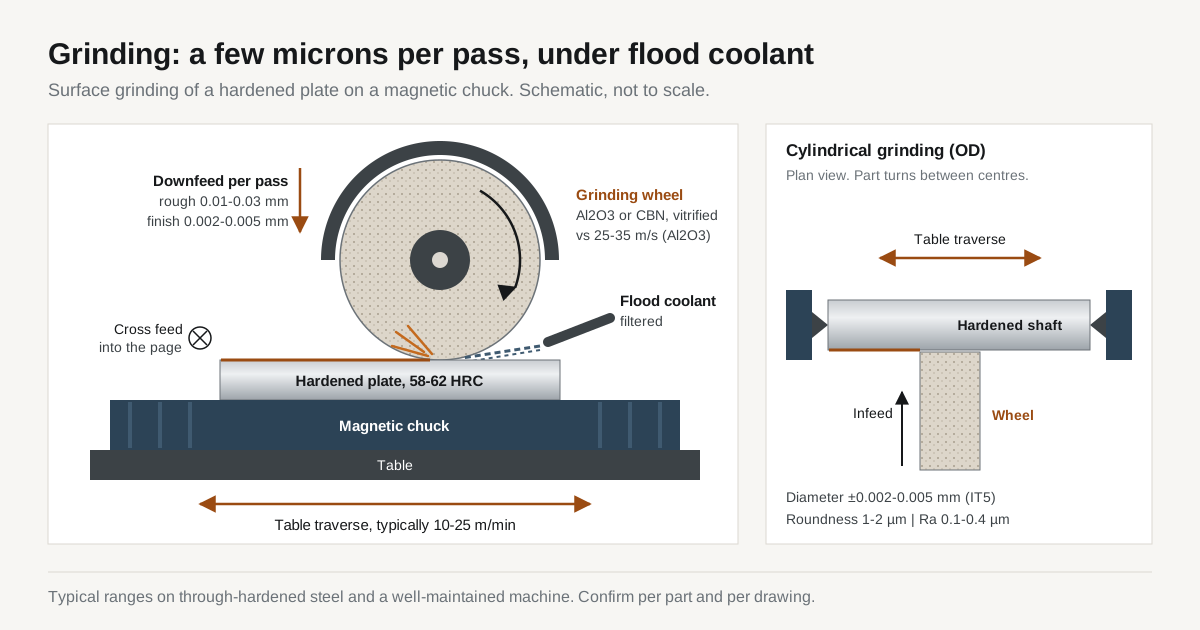
Grinding
Abrasive finishing of hardened parts after heat treatment. Typical ±0.002-0.005 mm, roundness 1-2 µm, Ra 0.1-0.4 µm on cylindrical work.
 04
Wire EDM
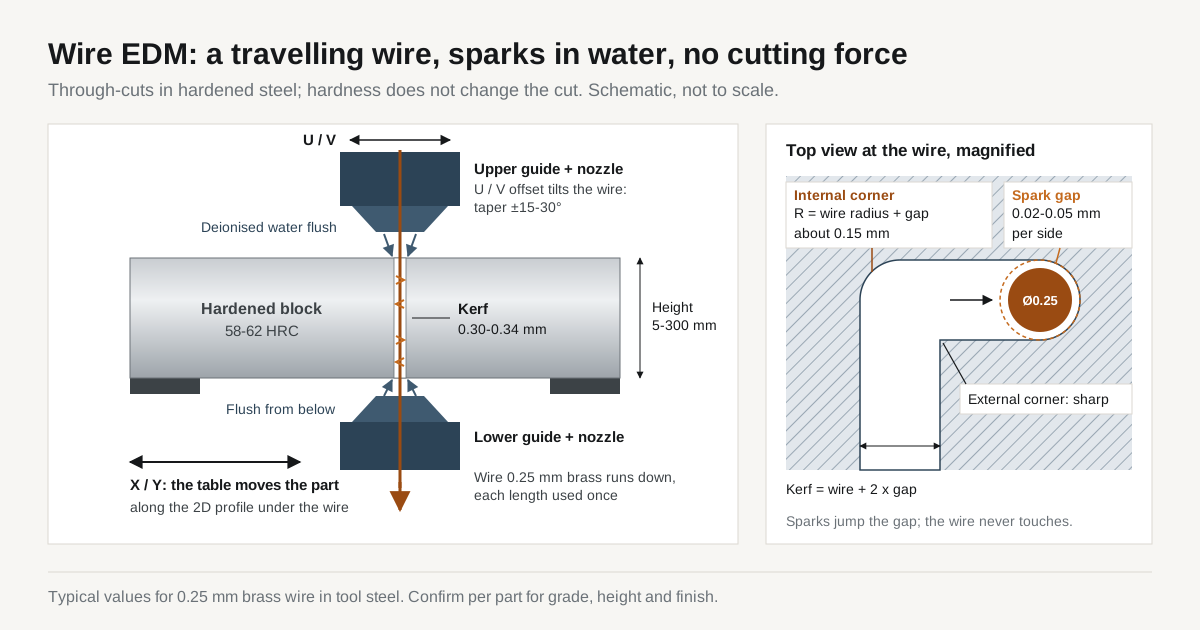
Spark erosion with a travelling wire through hardened plate. Holds ±0.005 mm and internal corners down to about R0.15 mm, on through-profiles only.
 05
Sinker EDM
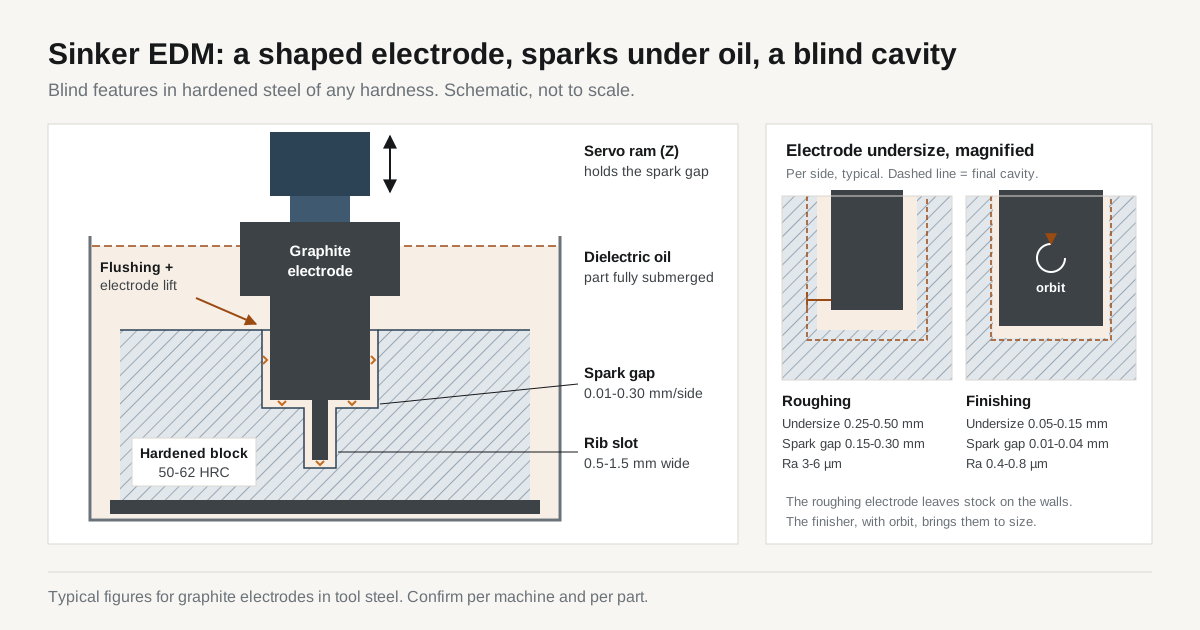
Blind cavities burned with a shaped graphite or copper electrode. Internal corners down to about R0.05-0.1 mm, deep ribs and VDI textures straight off the machine.
 06
Drilling and threading
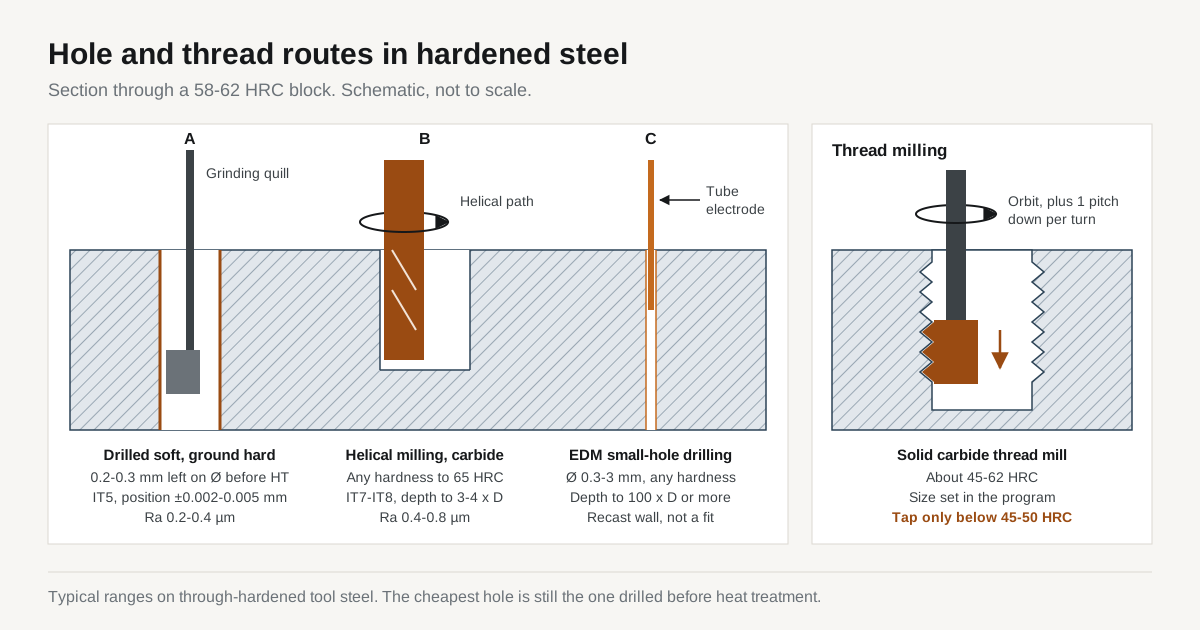
Holes and threads in 45-65 HRC steel: drill soft and finish hard, carbide drills, helical milling, jig grinding, EDM drilling and thread milling in place of tapping.
 07
Cutting hardened steel
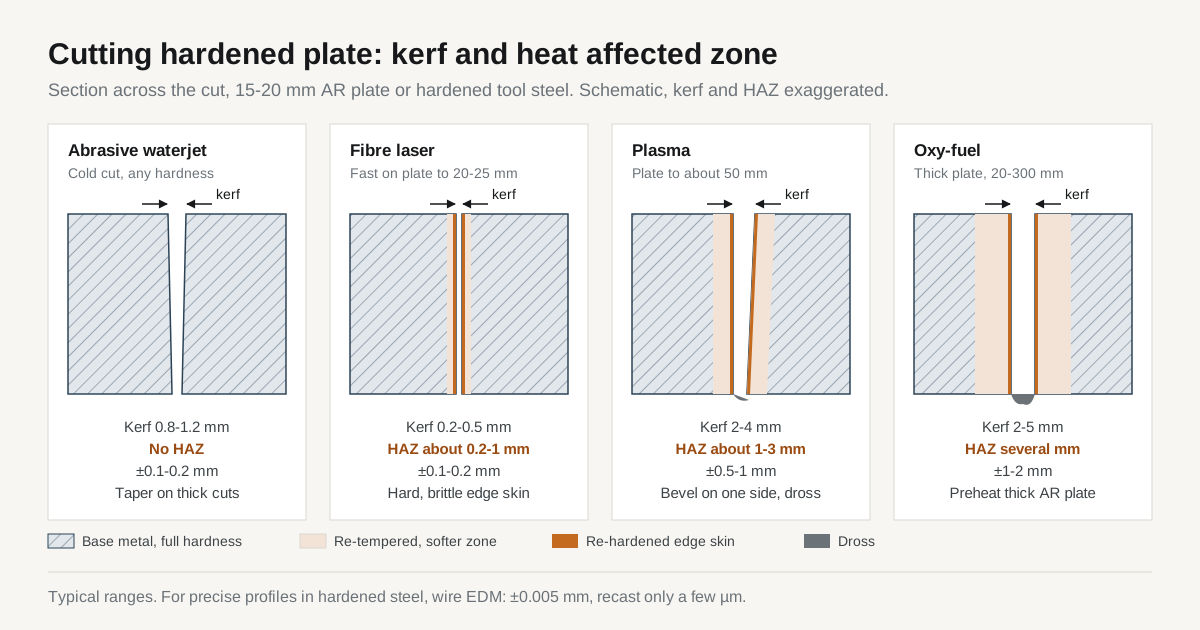
Sectioning and blanking hardened plate and bar: methods that work at 45-65 HRC, the heat each puts into the edge and the kerf, tolerance and thickness each holds.
 08
Lapping, honing and polishing
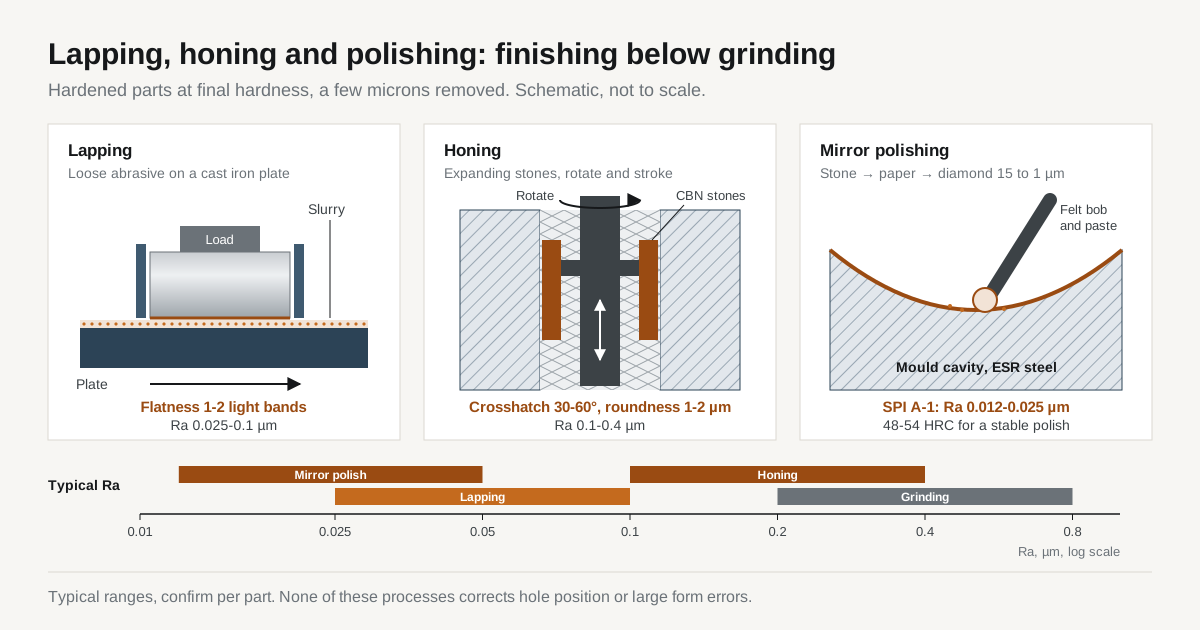
Finishing hardened parts beyond grinding: lapping for flatness, honing for bore form, superfinishing for shafts and mirror polishing for mould steel.
Decide from the drawing
Process by drawing feature
The feature with the tightest requirement usually sets the route for the whole part. Find it on the drawing and read across.
| Feature on the drawing | Process that holds it |
|---|---|
| Round diameters, IT6, short stiff part | Hard turning |
| 3D cavity, blends, contoured faces | Hard milling |
| Flatness or parallelism below 0.01 mm | Surface grinding |
| Diameter IT5, roundness below 2 µm, long shaft | Cylindrical grinding |
| Through profile, punch or die opening, sharp inside corners | Wire EDM |
| Blind pocket with sharp corners, deep narrow ribs | Sinker EDM |
| Threads or precision holes above 50 HRC | Thread milling, hard boring, jig grinding |
| Blank or profile cut from hardened plate | Waterjet, wire EDM, abrasive cut-off |
| Mirror finish, Ra below 0.1 µm, sealing faces | Lapping, honing, polishing |
Tolerance, finish and removal rate by process
Typical production figures on through-hardened tool steel. A specific shop, machine and part can be better or worse. Use them to compare processes, not to write tolerances.
| Process | Tolerance | Ra | Geometry | Removal rate |
|---|---|---|---|---|
| Hard turning | ±0.005-0.01 mm | 0.2-0.8 | Rotational | High |
| Hard milling | ±0.01 mm (±0.005 on features) | 0.2-0.8 | Full 3D | Medium-high |
| Grinding | ±0.002-0.005 mm | 0.1-0.4 | Flat, cylindrical, profile | Low |
| Wire EDM | ±0.005 mm | 0.3-1.6 (by skim cuts) | 2D and tapered through-cuts | Very low |
| Sinker EDM | ±0.01 mm | 0.4-3.2 | Blind 3D, ribs, sharp corners | Very low |
| Lapping / honing / polishing | ±0.001 mm, flatness in light bands | 0.02-0.1 | Flat, bores, freeform | Minimal |
Hybrid route. A quote with 1 process for the whole part is usually the higher quote. Route: mill or turn all features that allow it → grind or EDM only the critical faces. Details inhybrid routing.
Common questions
Hardness at which hard machining starts?
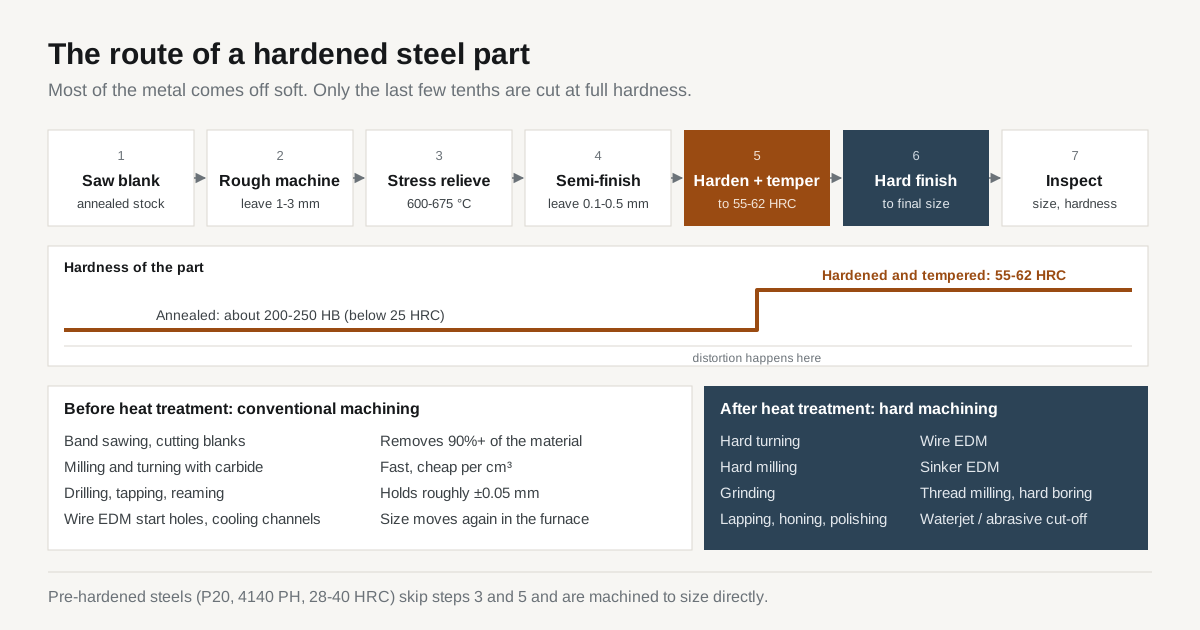
About 45 HRC. Below that, coated carbide tools on a standard machining centre or lathe cope with the steel. Above it, tool material, cutting data and machine rigidity all change. CBN and ceramic tools take over for cutting, and grinding and EDM take over for the tightest features. Pre-hardened steel at 28-40 HRC is still cut with carbide.
Machining before or after heat treatment?
Both, in sequence. Most material is removed soft, because soft machining is several times faster per cm³. The route is rough machine → stress relieve → semi-finish with 0.1-0.5 mm per side → harden and temper → hard finish to size. Only the final allowance is cut at full hardness, which removes the distortion from the furnace.
Lowest-cost process for a hardened part?
The route that finishes the most features in 1 setup. Hard turning and hard milling remove material fastest. Grinding and EDM are slower but are the only way to reach some tolerances and corner radii. The lowest-cost part usually combines them: mill or turn every feature that allows it, then grind or EDM only the critical ones. Confirm per drawing.
Pre-hardened steel without heat treatment?
Yes. Pre-hardened grades such as P20 and 4140 PH are supplied at 28-40 HRC. They are machined to size with carbide and need no furnace step. That removes heat treat distortion and the finishing allowance. The trade-off is lower hardness and wear resistance in service, so long-run or abrasive applications usually need a through-hardened grade.
Grades, hardness scales and heat treatment: hard steel materials.
Route proposal for a drawing
The drawing goes to shops that already run these processes on hardened steel. The written reply comes within 24 business hours and includes the proposed route with the price.