Machining process
Hard turning
Hard turning is single-point turning of steel after heat treatment, with CBN or ceramic inserts. On short, stiff round parts it often replaces cylindrical grinding. One setup, no coolant.
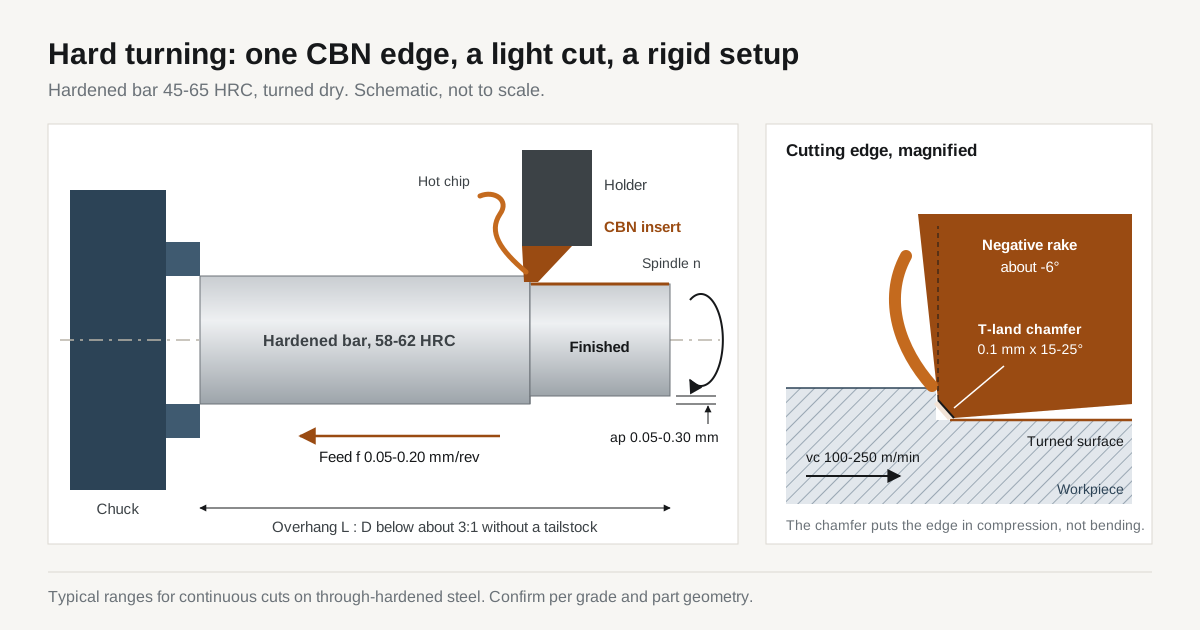
| Hardness range | 45-65 HRC; most work at 55-62 HRC |
|---|---|
| Tool | PCBN insert; mixed ceramic for continuous cuts below about 60 HRC |
| Cutting speed | 100-250 m/min |
| Feed | 0.05-0.20 mm/rev; wiper inserts about 2x feed at the same Ra |
| Depth of cut | 0.05-0.30 mm |
| Diameter tolerance | IT6: about ±0.005-0.008 mm on Ø30 mm |
| Roundness | 2-5 µm on a well-maintained lathe |
| Surface finish | Ra 0.2-0.8 µm |
| Coolant | None in most cases: dry or air blast |
| Typical parts | Bearing races; gear bores and hubs; shaft seats; pins; punches; bushings |
Definition and typical use
Hard turning is CNC turning of steel that has already been heat treated. Typical hardness is 55-62 HRC, sometimes up to 65 HRC. The part is finished after hardening, so furnace distortion is removed in the same operation. On many parts it takes the place of cylindrical grinding.
The process spread through bearing and transmission production once polycrystalline cubic boron nitride (PCBN) inserts became affordable. It now runs in any shop with a rigid, well-maintained CNC lathe.
Route of a hard-turned part: turn soft with 0.1-0.3 mm per side → harden and temper → hard turn to size → inspect.
Cutting mechanism
The CBN edge has a negative rake and a small T-land chamfer (see the edge detail above). The cutting force then loads the edge in compression. A sharp positive edge would chip in hardened steel.
The shear zone ahead of the edge heats up and the steel softens locally. The chip carries most of that heat away and often leaves the cut glowing. Flood coolant would cool this zone unevenly and shorten insert life. For that reason hard turning runs dry.
Depth of cut stays between 0.05 and 0.3 mm. The part must therefore reach heat treatment already turned close to size. Allowance by part size is in the heat treat allowance table.
Insert grades
| Insert | Application | Notes |
|---|---|---|
| Low-content PCBN (45-65% CBN, ceramic binder) | Continuous cuts, finishing, 55-65 HRC | Default grade for hard turning; highest chemical wear resistance |
| High-content PCBN (80-90% CBN) | Interrupted cuts, heavier stock removal | Tougher edge; lower heat resistance |
| Wiper PCBN | Finishing at higher feed | About 2x feed for the same Ra |
| Mixed ceramic (Al₂O₃-TiC) | Continuous cuts below about 60 HRC | Lower cost; low tolerance for interruptions |
| Coated carbide | Up to about 50 HRC | Pre-hardened and lightly hardened parts only |
Most hard turning inserts are tipped: a small PCBN segment brazed onto a carbide body. Solid PCBN inserts cost more and are used for heavy or interrupted cuts. Tool material trade-offs are covered in CBN vs carbide vs ceramic.
Tolerance and finish
Typical figures on a stiff part and a well-maintained lathe. Confirm per drawing.
| Property | Typical | Best case | Limit |
|---|---|---|---|
| Diameter | IT6, ±0.008 mm on Ø30 mm | ±0.005 mm | Lathe thermal stability |
| Roundness | 5 µm | 2 µm | Spindle runout |
| Surface finish | Ra 0.4-0.8 µm | Ra 0.2 µm | Edge condition and feed |
| Residual stress | Compressive | Compressive | Tensile with a worn edge |
Ra 0.2 µm needs a fresh wiper edge and a low feed. A worn edge flips residual stress to tensile and can leave a white layer. Lathe condition matters more than lathe brand: spindle runout, turret rigidity and thermal stability show up directly in size and finish.
Process limits
Long, slender parts. Hard turning forces are high relative to the depth of cut, mostly radial. A shaft with more than about 3 diameters of overhang deflects and chatters. A tailstock extends the range to about 6-8:1. Beyond that the part goes to a cylindrical grinder.
Very tight tolerances. IT5 and roundness below 2 µm belong to grinding. One part can hit them on a lathe. Holding them across a batch is a different matter.
Thin walls. A thin-walled bushing distorts in the chuck. Bored soft jaws or a collet reduce this. A very thin wall may need a different clamping concept.
Ground surface specified. Some aerospace and automotive standards name a ground surface. If the drawing says “ground”, the surface is ground.
Hard turning or grinding
| Factor | Hard turning | Grinding |
|---|---|---|
| Overhang (L:D) | Below 3:1 | Above 6:1 |
| Tolerance | IT6 or wider | IT5 or tighter |
| Finish | Ra 0.2 µm or rougher | Below Ra 0.2 µm |
| Geometry | Several diameters, faces, grooves and bores | 1-2 plain diameters |
| Batch | Small to medium, frequent changeovers | Long runs of 1 part |
| Contour | Profiles, tapers, radii | Plain cylinders |
The full comparison, including cost, is in hard turning vs cylindrical grinding. A common route: hard turn all features → grind only the 1-2 seats with the tightest callout.
Drawing and RFQ checklist
- Hardness after heat treatment with a band: 58-62 HRC, not “hardened”.
- Critical diameters marked, so the effort goes where it counts.
- Surface finish per surface. Ra 0.4 µm on a bearing seat and Ra 1.6 µm elsewhere costs much less than Ra 0.4 µm all over.
- Surface integrity on fatigue-loaded parts: “no white layer” plus the check method, usually 1 sectioned and etched sample per batch.
- Ground or not ground. “Turned or ground” opens the lower-cost route.
Grades that hard turn well: 52100; case-hardened 8620; 4140; D2; H13. High-carbide grades such as D2 wear inserts noticeably faster than 52100 at the same hardness. Material background is in hard steel materials.
Common questions
Hard turning as a replacement for grinding?
Often possible. Three conditions decide it: overhang below about 3:1 without a tailstock, tolerance IT6 or wider and a finish callout of Ra 0.2 µm or rougher. IT5, roundness below 2 µm or Ra 0.1 µm stay with grinding. The decision is made per feature, so one part can be turned on most diameters and ground on one seat.
Coolant in hard turning?
Usually none. The process uses the heat in the shear zone to soften the steel just ahead of the edge. Flood coolant cools that zone unevenly and thermally shocks the CBN, which then chips. Dry cutting or an air blast is standard. Coolant is used on some jobs only to hold part temperature and size, not to help the tool.
White layer risk in hard turning?
Yes, with a worn edge. White layer is a thin re-hardened surface layer that forms when the edge rubs instead of cutting. It is brittle and can start fatigue cracks. Shops control it by changing inserts at a fixed part count. On fatigue-loaded parts such as bearing races, the RFQ should ask how that interval is set and how the surface is checked.
Interrupted cuts: keyways, splines, cross holes?
Possible, with limits. Interrupted cuts need a high-CBN-content grade, a heavier edge chamfer and a lower cutting speed. Tool life drops and the cost per part rises. A cross hole is routine. A fully splined diameter is close to the practical limit and is assessed per drawing.
Cost of hard turning compared with grinding?
Usually lower on short round parts. One CNC lathe setup turns diameters, faces, grooves and bores together. Grinding the same part often takes 2-3 machines and setups. PCBN inserts are expensive, but cycle time and setup savings normally outweigh them. Long shafts and very tight tolerances reverse this result.