Machining process
Cutting hardened steel
Annealed tool steel is cut to blanks on a band saw. Hardened tool steel and AR400-AR500 wear plate need a choice between methods that heat the edge and methods that do not. The heat affected zone usually decides the method before the tolerance does.
| Band saw | Annealed steel with bimetal blades; carbide-tipped blades to about 45 HRC |
|---|---|
| Abrasive cut-off | Any hardness; edge burn risk without flood coolant |
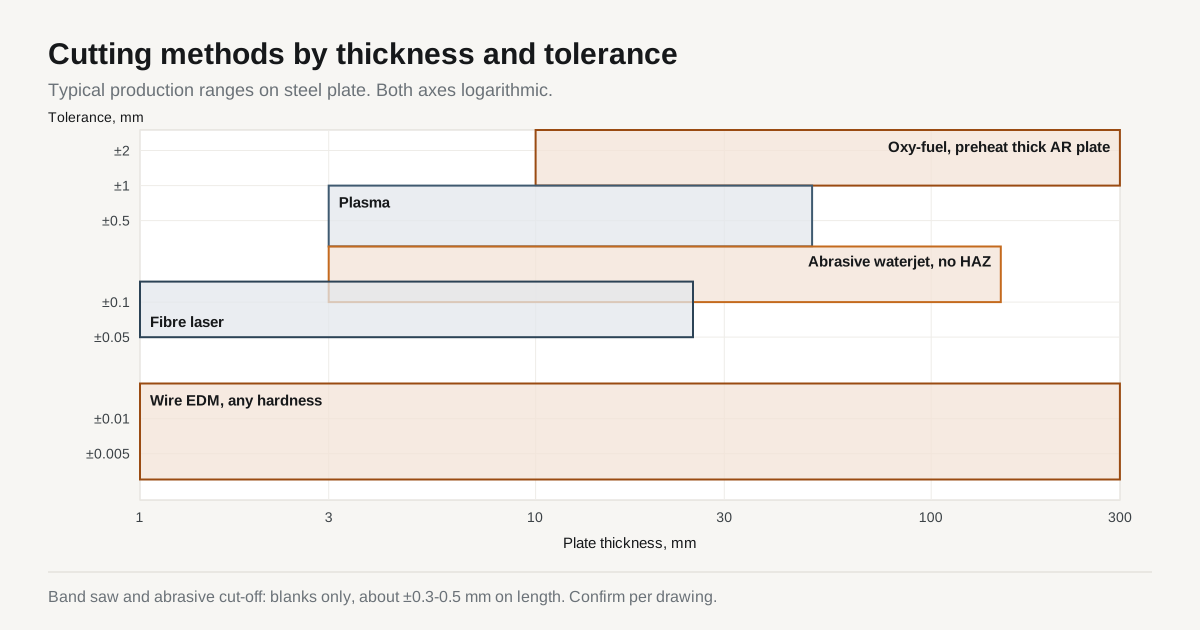
| Abrasive waterjet | Any hardness, no HAZ, kerf about 0.8-1.2 mm, ±0.1-0.2 mm |
| Fibre laser | AR plate to about 20-25 mm; HAZ about 0.2-1 mm, ±0.1-0.2 mm |
| Plasma | To about 50 mm; HAZ about 1-3 mm, ±0.5-1 mm, slight bevel |
| Oxy-fuel | Plate 20-300 mm; HAZ of several mm, ±1-2 mm, preheat on thick AR plate |
| Wire EDM | Any hardness, ±0.005 mm typical, recast of a few µm |
| Stock after thermal cutting | About 2-5 mm per side to machine away the HAZ |
Blanking and profile cutting of hardened steel
Cutting a hardened part covers 2 different operations:
- Blanking and sectioning. Separating plate or bar to size before machining, or making a finished wear part such as a liner.
- Profile cutting. A punch outline, die opening or gauge profile cut in steel at final hardness.
Blanking is judged on cost per cut and edge condition. Profile cutting is judged on tolerance and surface integrity. Different methods apply to each.
Heat from cutting and tempered steel
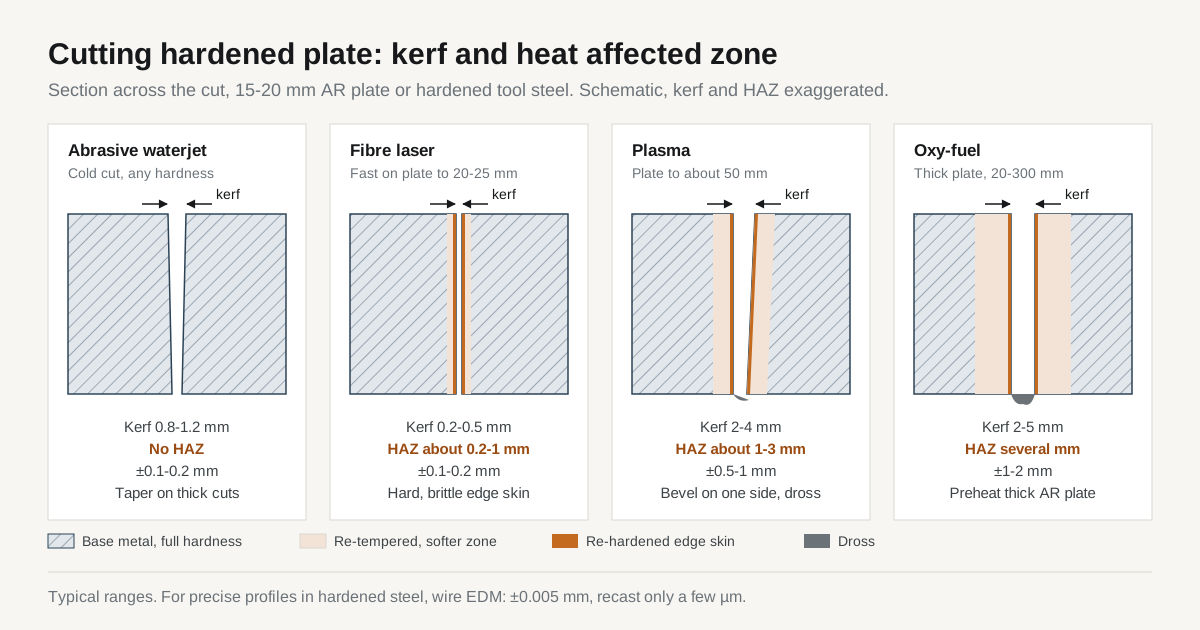
Heat from a cutting process tempers hardened steel. Most tool steels are tempered at 150-600 °C, and AR wear plates at low temperature or not at all. A cut that heats the edge above the original tempering temperature softens a band behind the edge.
A cut that melts the edge and cools it quickly also leaves a thin re-hardened, brittle skin. Soft band plus hard skin form the heat affected zone (HAZ).
Cold cutting methods without a heat affected zone
Band saw
The band saw is the standard tool for cutting annealed tool steel into blanks. Bimetal blades cut annealed grades at about 200-250 HB. Carbide-tipped blades reach about 45 HRC, which covers pre-hardened P20 and 4140 at 28-36 HRC.
| Band saw cut | Typical value |
|---|---|
| Kerf | About 1.5-2.5 mm |
| Length tolerance | About ±0.3-0.5 mm |
| Squareness | A few tenths of a mm per 100 mm |
| Heat damage | None |
| Hardness limit | About 45 HRC with carbide-tipped blades |
Blanks sawn soft are always oversize. The sequence is saw → machine → harden → finish.
Abrasive cut-off
An abrasive wheel cuts any hardness. A dry chop saw is quick and rough and can burn the edge. The burn shows as blue temper colour and a damaged skin of a few tenths of a millimetre.
A wet cut-off machine with a thin wheel and coolant gives a clean edge. It is used to section hardened parts and test pieces. Bar size is limited by the wheel, typically to about 100-150 mm.
Abrasive waterjet
A high-pressure water stream carrying garnet abrasive erodes the steel. Hardness has little effect on cutting speed and the material stays cold, so there is no HAZ. Waterjet suits small AR parts, hardened tool steel blanks and any part that needs full hardness at the edge.
| Waterjet on hardened steel | Typical value |
|---|---|
| Kerf | About 0.8-1.2 mm |
| Tolerance | About ±0.1-0.2 mm on thin plate, wider on thick plate |
| Edge taper | Present at high speed; reduced by taper compensation |
| Practical thickness | Up to about 100-150 mm at low speed |
| Edge finish | Ra about 3-6 µm, striations at the bottom of thick cuts |
Waterjet is much slower than laser on thin plate. Garnet embeds in the cut face and is cleaned off before welding.
Thermal cutting methods and their HAZ
| Method | Thickness on steel | Kerf | Tolerance | HAZ depth, typical | Notes |
|---|---|---|---|---|---|
| Fibre laser | To about 20-25 mm on AR plate | 0.2-0.5 mm | ±0.1-0.2 mm | About 0.2-1 mm | Fine detail, small holes; hard edge skin |
| Plasma | To about 50 mm | 2-4 mm | ±0.5-1 mm | About 1-3 mm | Bevel of 1-3° on one side, dross |
| Oxy-fuel | About 20-300 mm | 2-5 mm | ±1-2 mm | Several mm | Preheat and slow cool on hardened grades |
These are production ranges on carbon and low-alloy steel. HAZ depth depends on thickness, speed and grade. The plate maker’s data sheet is the reference for a specific AR grade.
Laser cutting
Laser is the fastest route for AR400-AR500 plate up to about 20 mm. It is also the most accurate thermal method. The HAZ is shallow, but the edge is often harder than the plate because of rapid self-quenching.
That hard skin can crack when the part is bent across the cut. It also wears drills and taps at the edge. On high-carbon hardened tool steel, laser cutting risks edge cracks and is rarely used on finished parts.
Plasma cutting
Plasma cuts thicker plate faster and at lower cost than laser. Kerf is wider, one side carries a bevel and the HAZ is deeper. It is the usual method for wear liners whose cut edge is neither functional nor machined.
Oxy-fuel cutting
Oxy-fuel covers thick plate above about 25-30 mm, beyond the reach of laser and plasma. It puts the most heat into the part. Thick AR and alloy plate needs preheat before cutting and slow cooling after it.
Plate makers commonly specify preheat around 100-200 °C. The thickness at which preheat starts is typically about 20-40 mm, depending on grade. Without preheat, hydrogen and quench stresses can crack the edge hours after cutting.
Heat affected zone effects on parts
- Small parts and narrow strips. A thermal cut on a piece only a few times wider than the HAZ can heat the whole section. A 30 mm wide strip of AR500 cut by plasma may lose hardness across its full width. Waterjet avoids this.
- Parts machined after cutting. The re-hardened skin wears drills and end mills, and its cracks can extend into the part. About 2-5 mm per side is left to machine away the HAZ, more on thick plate.
- Parts under bending or fatigue load. Cracked or soft edges start failures. Load-carrying edges are waterjet cut, machined back past the HAZ or both.
For liners and wear parts whose edge sits in a chute, a thermal edge is usually acceptable. Plate grades and their specification are in the wear plate guide.
Wire EDM for precise profiles in hardened steel
Parts already at final hardness with a precise profile need wire EDM. Typical examples are punches, die openings, stripper plates and gauges. Wire EDM cuts any hardness to about ±0.005 mm with a kerf of about 0.3 mm.
After skim cuts the recast layer is a few microns. Thick sections cut slowly, and internal profiles need a start hole. Start hole options are on the drilling and threading page.
Wire EDM is also the practical route to sharp internal corners. Details are in wire EDM for sharp corners.
Cutting method selection by part
| Situation | Usual method |
|---|---|
| Tool steel blank before heat treatment | Band saw on annealed bar → machine |
| Pre-hardened P20 or 4140 blank, 28-36 HRC | Carbide-tipped band saw or waterjet |
| Hardened tool steel, rough section or test piece | Wet abrasive cut-off |
| Hardened tool steel, rough profile with full edge hardness | Waterjet → grind or hard mill |
| Hardened tool steel, finished precision profile | Wire EDM |
| AR400-AR500 liners up to 20 mm | Laser |
| AR plate 20-50 mm, edges not critical | Plasma |
| AR plate above about 40-50 mm | Oxy-fuel with preheat, or waterjet |
| Small AR parts, narrow strips, fatigue-loaded edges | Waterjet |
A cut edge is rarely the finished surface on a precision part. Flat faces are ground after cutting, and holes follow the routes on the drilling page.
Drawing and RFQ callouts for cut parts
- Material and delivered condition. “D2, annealed” or “AR500 plate”. The shop selects the cutting method from this.
- Functional edges. Edges that need full hardness or a tolerance are marked; the rest may stay as thermally cut.
- HAZ requirement. “No thermal cutting on edges marked X” or “remove HAZ by machining, minimum 3 mm”.
- Edge tolerance and squareness per edge, not one blanket value.
- Thickness and plate standard, so preheat and method can be planned.
- Hardness test position. Distance from the cut edge, if hardness is checked near it.
The drawing and plate grade go through the RFQ form.
Common questions
Band saw on hardened tool steel?
Only up to about 45 HRC, with carbide-tipped blades at low speed. Even then the cut is slow and blade wear is high. Fully hardened D2 or M2 at 58-64 HRC is cut with an abrasive wheel, wire EDM or waterjet. The normal sequence is saw annealed bar → machine → harden. The hardness on delivery decides the method, so the RFQ should state the material condition.
Hardness loss in AR500 after thermal cutting?
Yes, in a band behind the cut edge. AR plate gets its hardness from quenching and a low-temperature temper. Cutting heat re-tempers a band to lower hardness, and the edge itself can re-harden into brittle martensite. Small parts and narrow strips can lose hardness across the full section. Waterjet avoids both effects. The plate maker's data sheet gives the HAZ depth per grade and thickness.
Machining stock after flame or plasma cutting?
Typically 2-5 mm per side for tool steel blanks and wear parts that are machined afterwards. This removes the heat affected zone and any edge cracks. Thick plate and oxy-fuel cuts need the upper end of the range or more. The plate maker's data for grade and thickness sets the minimum. The shop confirms the allowance per part when it plans the cutting route.
Wire EDM cost compared with waterjet?
Wire EDM costs several times more per part and runs much slower on thick sections. It pays when the part is already hardened and the profile is precise: punches, die openings, gauges and sharp internal corners. It holds about ±0.005 mm and leaves a recast of a few microns. Rough blanks and plate liners go to waterjet or laser. Profile tolerance and edge function decide the method.
Preheat before cutting AR plate?
Often yes on thick plate, mostly with oxy-fuel and plasma. Plate makers publish preheat temperatures by grade and thickness. Preheat commonly starts somewhere around 20-40 mm thickness, at about 100-200 °C. Without it, the cut edge can crack hours after cutting. Laser and waterjet on thinner plate normally need no preheat. The data sheet of the specific plate grade is the reference.