Material knowledge
Surface hardening
Wear, galling and contact fatigue act in the first fraction of a millimetre. A hard case over a tough core puts hardness where the load is. The process choice sets case depth, distortion and the machining sequence.
| Carburizing | Effective case 0.5-2.0 mm, 58-62 HRC, on 8620, 9310, 20MnCr5 |
|---|---|
| Induction hardening | Case about 1-6 mm, 50-58 HRC, on 4140, 1045, 42CrMo4 |
| Gas or plasma nitriding | Case 0.1-0.6 mm, about 900-1200 HV on H13, no quench |
| Nitrocarburizing | Compound layer about 10-20 µm, short cycle near 570 °C |
| PVD coating | Film 1-5 µm, about 1800-3500 HV, deposited at about 200-500 °C |
| Hard chrome | About 5-250 µm, 800-1000 HV, hydrogen bake on hardened steel |
| Lowest distortion | PVD, nitriding, hard chrome |
| Highest distortion | Carburizing and CVD (full quench or re-hardening) |
| Case depth on drawing | Effective depth to a stated hardness, e.g. 550 HV, after final grinding |
Purpose of a hardened case
Through hardening a shaft to 58 HRC makes the core brittle and distorts the whole section in the quench. Surface hardening puts hardness at the load and keeps a core that takes bending and shock. A crack that starts in the case stops in the tough core.
Surface hardening processes fall into 3 groups:
| Group | Processes | Mechanism | Result |
|---|---|---|---|
| Diffusion + quench | Carburizing, carbonitriding | Carbon (and nitrogen) added to a low-carbon steel, then quenched | Deep case, high hardness, high distortion |
| Local heating + quench | Induction, flame | Surface of a medium-carbon steel heated and quenched, no chemistry change | Deep case on selected zones only |
| Low-temperature layer | Nitriding, nitrocarburizing, PVD, hard chrome | Diffusion below the tempering temperature, or a deposited film | Thin layer, low distortion |
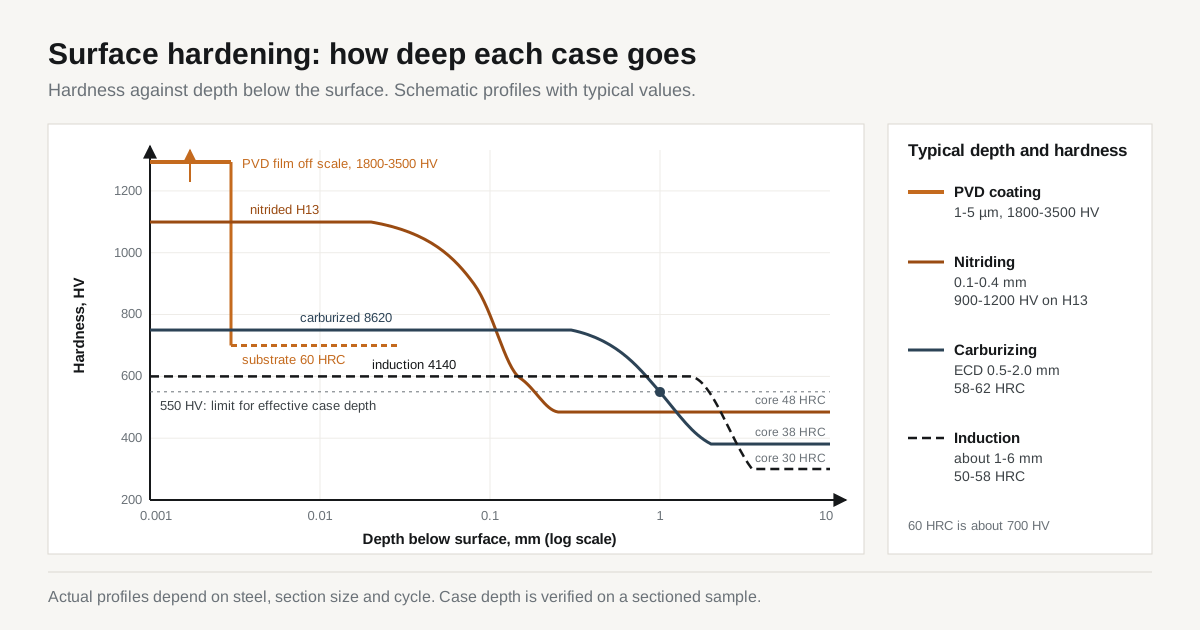
The hero chart compares typical hardness profiles on a log depth scale. A PVD film is about 1000 times thinner than an induction case. Base steel families are introduced in the overview of hard steel families.
Carburizing and case hardening
Low-carbon steel (about 0.15-0.25% C) is held at about 900-950 °C in a carbon-rich atmosphere until carbon diffuses to the required depth. The part is then quenched and tempered at about 150-200 °C. Case hardness reaches 58-62 HRC and the core stays at about 30-45 HRC.
| Item | Typical value |
|---|---|
| Steels | 8620, 9310, 20MnCr5, 16MnCr5 |
| Effective case depth | 0.5-2.0 mm, gears and shafts |
| Depth vs time | Depth grows with the square root of time, so 2x depth needs about 4x cycle |
| Soft areas | Masked with copper plating or stop-off paint, or extra stock removed before the quench |
Sequence for soft threads: machine with extra stock → carburize → remove the case at the threads → harden → temper → grind. The comparison with through hardening is in case hardening vs through hardening.
Carbonitriding
Carbonitriding runs at about 820-900 °C with ammonia added, so nitrogen enters with the carbon. The case is shallower, typically 0.1-0.75 mm, with less distortion than carburizing. It is used on small, high-volume parts in low-carbon and free-machining steels.
Induction and flame hardening
An induction coil heats a surface layer of medium-carbon steel above its hardening temperature in seconds. A water-polymer spray quenches it, and only the heated zone hardens. Surface hardness is about 50-58 HRC, set by the carbon content.
| Item | Typical value |
|---|---|
| Steels | 1045, 4140, 42CrMo4, 4340 |
| Case depth | About 1-6 mm, set by frequency and heating time |
| Core | Often quenched and tempered beforehand to 28-32 HRC |
| Distortion | Low to moderate, local to the hardened zone |
Flame hardening uses a gas torch on large parts such as machine ways and big gears. Control of depth and pattern is less precise than with induction.
Nitriding and plasma nitriding
Nitrogen diffuses into the surface at about 500-550 °C in ammonia gas or a plasma. Hard nitrides form with chromium, molybdenum, vanadium and aluminium, so the result depends on the alloy. There is no phase change and no quench.
| Steel | Typical surface hardness after nitriding |
|---|---|
| H13 | About 900-1200 HV |
| 4140 | About 550-700 HV |
| P20 | About 550-700 HV |
| Nitriding steels (Al-bearing) | About 900-1100 HV |
Case depth is typically 0.1-0.4 mm. Gas nitriding cycles often run 20-60 hours. The part grows by about 0.005-0.025 mm per surface.
The steel is hardened and tempered at least about 30 °C above the nitriding temperature. Otherwise the core softens. Low-tempered D2 is rarely nitrided for this reason.
A brittle compound layer (white layer), typically 5-15 µm, forms on top of the case. Plasma nitriding can suppress it where impact or thermal shock would flake it. Sequence and stock are covered in nitriding and PVD after hard machining.
Nitrocarburizing
Nitrocarburizing adds nitrogen and some carbon at about 560-590 °C for a few hours, in gas or salt bath. The main product is a compound layer of about 10-20 µm over a diffusion zone. It improves wear and galling resistance on most carbon and alloy steels, and corrosion resistance after post-oxidation.
The layer is thin and does not carry high contact stress. Under heavy load it collapses into the softer steel beneath.
PVD and CVD coatings
Physical vapour deposition (PVD) lays down a ceramic film 1-5 µm thick at about 200-500 °C. Method background: physical vapor deposition.
| Coating | Typical hardness | Typical use |
|---|---|---|
| TiN | About 2300 HV | General wear, punches |
| TiAlN | About 3000-3500 HV | Cutting edges, higher temperature |
| CrN | About 1800-2200 HV | Forming, anti-galling |
| DLC | Varies by type, deposited below about 250 °C | Low friction, non-ferrous contact |
The film copies the surface under it, so the sequence is polish → hone edges → coat. The substrate is hardened and tempered above the coating temperature.
Chemical vapour deposition (CVD) gives thicker, adherent films at about 900-1050 °C. A tool steel part is re-hardened after coating, with the distortion that follows. Use on tool steel is limited to forming and drawing tools where adhesion justifies the cost.
Hard chrome plating
Electroplated chromium is about 5-250 µm thick at about 800-1000 HV. Plating runs near 50-60 °C, so the part does not distort. Thick deposits are ground back to size.
Hardened steel is baked after plating, usually within a few hours, to remove hydrogen. Without the bake, the part can crack from hydrogen embrittlement.
Process comparison table
| Process | Case or layer depth | Surface hardness | Distortion | Typical steels | Machining sequence |
|---|---|---|---|---|---|
| Carburizing | 0.5-2.0 mm effective | 58-62 HRC | High | 8620, 9310, 20MnCr5 | Machine soft with grind stock → mask → harden → grind |
| Carbonitriding | 0.1-0.75 mm | 58-63 HRC | Moderate | 1018, 12L14, 8620 | Machine near size → treat → grind critical fits |
| Induction | About 1-6 mm | 50-58 HRC | Low to moderate, local | 1045, 4140, 42CrMo4 | Machine with stock on zones → harden → temper → grind zones |
| Flame | About 1.5-6 mm | 50-58 HRC | Moderate | 1045, 4140, cast iron | As induction, larger stock |
| Gas or plasma nitriding | 0.1-0.6 mm | 550-1200 HV (alloy dependent) | Low, growth 5-25 µm | H13, 4140, P20, nitriding steels | Harden, temper → stress relieve → finish to size minus growth → nitride → light lap |
| Nitrocarburizing | 10-20 µm compound + diffusion zone | 500-1000 HV (steel dependent) | Low | Most carbon and alloy steels | Finish machine → treat → polish |
| PVD | 1-5 µm | 1800-3500 HV | Negligible | Hardened tool steels tempered above coating temperature | Finish grind → polish → hone → coat |
| CVD | 5-15 µm | About 3000 HV | High (re-hardening) | Selected tool steels | Machine → coat → re-harden in vacuum → minimal finishing |
| Hard chrome | 5-250 µm | 800-1000 HV | None | Most steels | Grind undersize → plate → bake → grind to size |
Figures are typical production ranges. The heat treater or coater confirms values per steel, section and drawing.
Case depth, core support and grinding
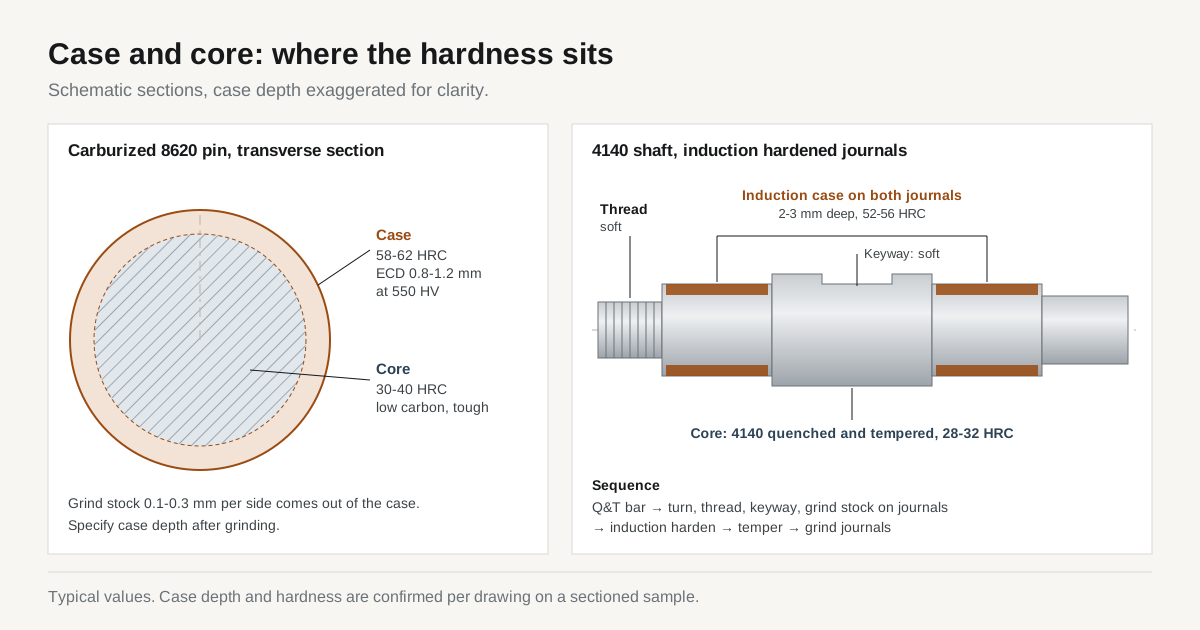
- Case depth against the load. Under contact stress the peak shear stress sits below the surface. A case shallower than that depth is pushed into the core and spalls. Thin layers suit wear and galling, and deep cases suit gears, rolls and loaded journals.
- Core support. A thin case needs a hard core beneath it. Typical pairs: 4140 at 28-32 HRC under an induction case, H13 at 44-50 HRC under nitriding, 60 HRC tool steel under PVD.
- Grinding after treatment. Each 0.1 mm ground off a carburized or induction case is 0.1 mm less case. On nitrided parts, grinding more than a few microns removes the hardest layer. Typical stock figures are in the heat treat allowance table.
Process selection by part type
| Requirement | Typical process |
|---|---|
| Whole surface hard, complex shape, high contact load (gears, cams, pins) | Carburizing |
| Round part, hardness on journals or seats only, low distortion | Induction on 4140 or 1045 |
| Finished precision part, wear or galling, no size change allowed | Nitriding on H13, 4140 or P20; nitrocarburizing |
| Hardened tool steel edge, longer wear life | PVD, with nitriding first under high load |
| Rods, rolls, sliding surfaces, low friction and corrosion resistance | Hard chrome, or nitrocarburize + oxidize |
Parts that need hardness through the whole section belong on the heat treatment page. Base steel choice is covered in toughness vs wear resistance.
Drawing requirements for surface-hardened parts
- Process and steel. “Carburize and harden, 8620” or “Gas nitride, H13 hardened and tempered 46-50 HRC before nitriding”.
- Surface hardness scale. HRC for carburized and induction cases. HV with a stated load for nitrided cases, because an HRC indent passes through a thin case.
- Effective case depth. With its limit hardness, e.g. “ECD 0.8-1.2 mm at 550 HV, after grinding”. For nitriding, state the depth and its definition.
- Core hardness. Where the core carries load.
- Hardened and soft zones. Induction zones dimensioned on the drawing, masked areas marked.
- Compound layer. A thickness limit, or “no compound layer” for nitrided parts under impact.
- Coating type and thickness. Coated surfaces marked, film thickness included in the tolerance of precision fits.
- Verification. A sectioned coupon from the same batch with a microhardness traverse.
Terms such as case depth and compound layer are defined in the glossary. Drawings with these notes can be sent through the RFQ form.
Common questions
Carburized 8620 or induction hardened 4140?
Carburizing suits parts where the whole surface needs 58-62 HRC, including gear teeth and small radii. Induction suits round parts where only a few diameters or faces need hardness and low distortion matters. Induction on 4140 reaches about 50-58 HRC, a few points below a carburized case. The choice is set by the hardened area, the contact load and the grinding stock available.
Nitriding after finish machining?
Yes, this is the normal sequence. Nitriding runs at about 500-550 °C with no quench. The part grows by about 0.005-0.025 mm per surface, so the fit is machined to size minus the expected growth. The steel is hardened and tempered above the nitriding temperature first. Without that step, the core softens during the cycle. The treater confirms the growth per steel and case depth.
Causes of PVD coating flaking?
The usual causes are a soft substrate, a contaminated surface or a temper below the coating temperature. A 3 µm film on soft steel cracks under contact load because the steel beneath deforms. A part tempered below the chamber temperature softens during coating. Duplex treatment (nitride → coat) gives the film a hard base. The coater confirms substrate hardness and temper requirements per grade.
Grinding stock on a carburized part?
Typically 0.1-0.3 mm per side, set by part size and expected distortion. The stock comes out of the case. A 1.0 mm effective case with 0.3 mm ground off leaves about 0.7 mm. The drawing states case depth after grinding, and the heat treater is told how much stock will be removed. Final stock is confirmed per part with the shop.
Hard chrome as a current option?
Technically yes. Hard chrome gives about 800-1000 HV with low friction and corrosion resistance on rods and rolls. Hexavalent chromium plating is under increasing restriction, particularly in the EU. Acceptance depends on the end market and the plating supply chain. Hardened steel is baked after plating to remove hydrogen, usually within a few hours, to avoid embrittlement cracking.
Total case depth vs effective case depth?
Effective case depth is the figure for the drawing. It is the depth at which hardness falls to a stated value, commonly 550 HV for carburized cases. It is measured by a microhardness traverse on a sectioned sample. Total case depth is where composition or structure stops differing from the core. That boundary is hard to measure and has little practical use.