Material knowledge
Alloying elements in tool steel
A tool steel grade is a recipe of carbon and a few alloying elements. Each element shifts hardenability, carbide type, wear resistance, temper resistance or corrosion. Knowing the recipe explains why D2 wears well, H13 survives heat and 420 resists rust.
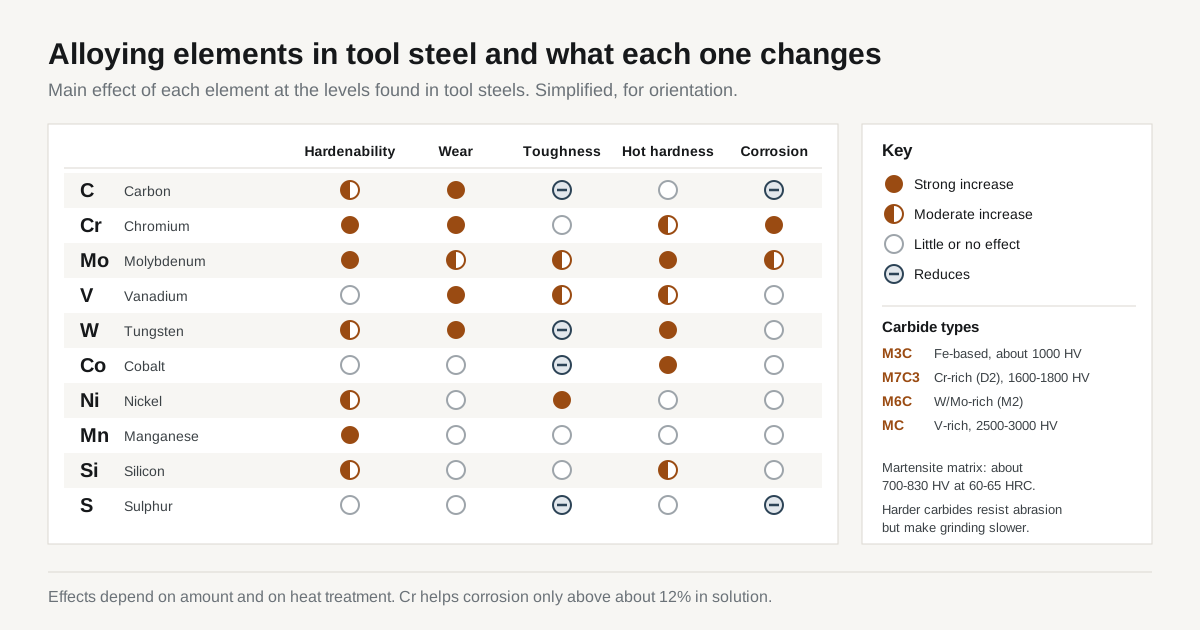
| Carbon | 0.35-1.55% in common tool steels. Sets martensite hardness and carbide volume |
|---|---|
| Max. martensite hardness | About 65 HRC, reached at about 0.6% C dissolved |
| Chromium | 0.5-17%. Hardenability, M7C3 carbides, corrosion above about 12% in solution |
| Molybdenum and tungsten | Hardenability, hot hardness, M6C carbides. 1% Mo does the work of about 2% W |
| Vanadium | 0.2-2% in standard grades, up to about 10% in PM grades. Hardest carbide, MC |
| Carbide hardness | M3C about 1000 HV | M7C3 1600-1800 HV | MC 2500-3000 HV |
| Martensite matrix | About 700-830 HV at 60-65 HRC |
| Free-machining sulphur | About 0.05-0.15% S in resulphurised mould steels |
Carbon: martensite hardness and carbide volume
Carbon sets the hardness of martensite. Hardness rises with dissolved carbon up to about 0.6%, where martensite reaches about 65 HRC. More carbon than that does not harden the matrix further.
Extra carbon forms carbides with iron and the alloying elements. Carbide volume, not matrix hardness, is what separates a 1.5% C grade like D2 from a 0.4% C grade like H13. More carbide means more wear resistance and less toughness.
| Carbon level | Typical grades | Result |
|---|---|---|
| 0.35-0.55% | P20, H13, S7, 4140 | Tough matrix, 28-58 HRC, few carbides |
| 0.85-1.05% | O1, A2, M2, 52100, 440C | 58-65 HRC, moderate carbide volume |
| 1.5% and above | D2, D3 | High carbide volume, high wear resistance, lower toughness |
Chromium: hardenability, M7C3 carbides and corrosion
Chromium raises hardenability, so thicker sections harden with a slower quench. 5% Cr in A2 and H13 is enough for air hardening on moderate sections.
At 12% Cr with 1.5% C, as in D2, chromium forms large M7C3 carbides of about 1600-1800 HV. These carbides give D2 its abrasion resistance. They also lower toughness and make the steel harder to grind.
Corrosion resistance needs roughly 12% chromium dissolved in the matrix, not just present in the steel. 420 mould steel at about 13% Cr and 0.4% C keeps enough in solution. 440C at 17% Cr combines corrosion resistance with high carbide volume.
Molybdenum and tungsten: hot hardness and M6C carbides
Molybdenum is a strong hardenability element. It also slows softening during tempering and gives secondary hardening at about 500-540 °C. H13 and M2 depend on it.
Tungsten acts in a similar way, with about twice the atomic weight. 1% Mo does roughly the work of 2% W. Both form M6C carbides and raise hot hardness, the ability to stay hard at red heat.
M2 carries about 5% Mo and 6% W. That combination keeps a cutting edge hard at temperatures where D2 softens. The tempering curves show the effect.
Vanadium: MC carbides and grain size
Vanadium forms MC carbides, the hardest carbide type in tool steel at about 2500-3000 HV. Even 0.2-1% V refines grain size and improves toughness at a given hardness.
Higher vanadium adds wear resistance. M2 has about 1.9% V.
Powder metallurgy grades reach about 4-10% V with fine, even carbide distribution. See PM tool steels for how this affects machining.
The cost is grindability. MC carbides are harder than aluminium oxide abrasive, so high-V grades need CBN wheels. The grinding page covers wheel choice.
Cobalt and nickel: elements that stay in the matrix
Neither element forms carbides. Both stay dissolved in the matrix and change its behaviour.
- Cobalt. Raises hot hardness in high-speed steel, about 8% in M42. It slightly lowers toughness and does not add hardenability.
- Nickel. Raises toughness and hardenability. P20+Ni (1.2738) adds about 1% Ni for even hardness through thick mould blocks. Maraging steels use about 18% Ni.
Manganese, silicon and sulphur
Manganese is a low-cost hardenability element. O1 uses about 1.2% Mn to harden in oil. High Mn lowers Ms and raises retained austenite.
Silicon strengthens the matrix and adds temper resistance. H13 and H11 carry about 1% Si.
Sulphur is an impurity in most grades, below about 0.03%. Resulphurised mould steels add about 0.05-0.15% S, which forms manganese sulphide. Chips break better, but polishability and transverse toughness drop.
Hardenability and section size
Hardenability is the depth to which a steel hardens in a given quench. It is a separate property from maximum hardness, which depends on carbon. Mn, Cr, Mo and Ni raise hardenability, and Mo has the strongest effect per percent.
| Hardenability level | Grades | Quench needed | Distortion |
|---|---|---|---|
| Low | Plain carbon steel | Water or brine | High |
| Medium | O1, 52100, 4140 | Oil | Moderate to high |
| High | A2, D2, H13, S7, M2 | Air or vacuum gas | Low |
A slower quench means a smaller thermal gradient and less distortion. That is the main reason air-hardening grades cost less to finish after heat treatment. Thick blocks need high hardenability for even hardness to the core, which is why P20+Ni is used on large mould blocks.
Carbide types and their hardness
| Carbide | Main elements | Approx. hardness | Found in |
|---|---|---|---|
| M3C | Fe (cementite) | About 1000 HV | Carbon and low-alloy steel, O1, 52100 |
| M7C3 | Cr | 1600-1800 HV | D2, D3, 440C |
| M6C | W, Mo | Harder than M7C3, below MC | M2, M42 |
| MC | V | 2500-3000 HV | H13 (small amount), M2, PM grades |
| Martensite matrix | Fe, C | 700-830 HV at 60-65 HRC | All hardened tool steel |
Carbides harder than the abrasive in the work material resist wear. Size matters as well: large, clustered carbides start cracks, fine even carbides do not.
Nominal composition of common grades
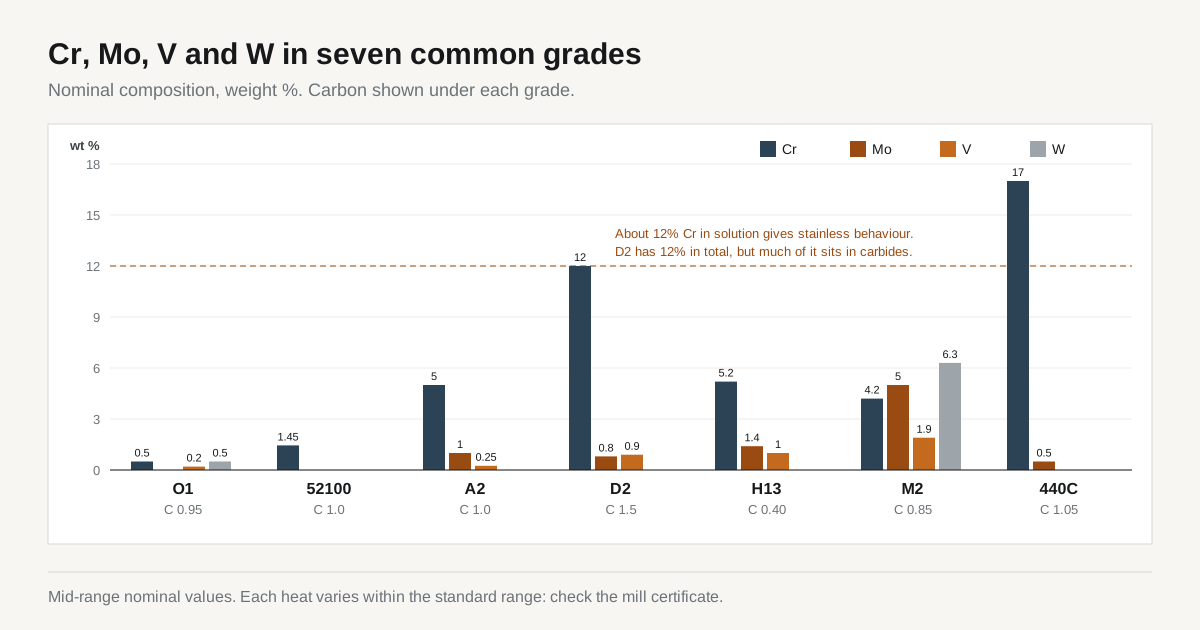
Typical nominal values in weight %. Each standard gives ranges, and each heat varies within them.
| Grade | C | Mn | Si | Cr | Mo | V | W | Quench |
|---|---|---|---|---|---|---|---|---|
| D2 | 1.50 | 0.3 | 0.3 | 12.0 | 0.8 | 0.9 | - | Air, gas |
| A2 | 1.00 | 0.6 | 0.3 | 5.0 | 1.0 | 0.25 | - | Air, gas |
| O1 | 0.95 | 1.2 | 0.3 | 0.5 | - | 0.2 | 0.5 | Oil |
| H13 | 0.40 | 0.35 | 1.0 | 5.2 | 1.4 | 1.0 | - | Gas, air, oil |
| S7 | 0.50 | 0.7 | 0.3 | 3.25 | 1.4 | optional | - | Air, oil |
| M2 | 0.85 | 0.3 | 0.3 | 4.2 | 5.0 | 1.9 | 6.3 | Gas, salt |
| P20 | 0.35 | 0.8 | 0.5 | 1.7 | 0.4 | - | - | Pre-hardened |
| 420 mould | 0.38 | max. 1.0 | max. 1.0 | 13.0 | - | - | - | Air, gas, oil |
| 440C | 1.05 | max. 1.0 | max. 1.0 | 17.0 | 0.5 | - | - | Air, oil |
| 52100 | 1.00 | 0.35 | 0.25 | 1.45 | - | - | - | Oil |
Plain 420 starts at 0.15% C. Mould-grade 420 (1.2083) sits at about 0.38% C for 48-52 HRC.
Grade families explained by composition
- D2. 1.5% C and 12% Cr give a large volume of M7C3 carbide. High abrasion resistance, moderate toughness, air hardening.
- A2. 1% C and 5% Cr with 1% Mo. Air hardening with low distortion, fewer carbides than D2 and more toughness. Compared in A2 vs D2.
- O1. About 1% C with Mn, Cr and W at low levels. Oil hardening, low cost, more distortion.
- H13. 0.4% C keeps carbides low for toughness. 5% Cr, 1.4% Mo and 1% V give temper resistance and secondary hardening for hot work.
- S7. 0.5% C with Cr and Mo. Few carbides, high impact toughness at 54-58 HRC.
- M2. Mo, W and V with about 0.85% C. Secondary hardening to 62-65 HRC and hot hardness for cutting edges.
- P20. 0.35% C with Cr and Mo. Supplied pre-hardened at 28-34 HRC for moulds, no hardening step.
- 420. About 13% Cr in solution with about 0.4% C. Corrosion resistance for mould cavities at 48-52 HRC.
The same grades with their JIS, DIN and GB names are in tool steel grade equivalents. The family overview is on hard steel materials.
Composition on the drawing and purchase order
- Name the grade with its standard. D2 per ASTM A681, or 1.2379 per EN ISO 4957. Equivalents are close, not identical.
- Ask for the heat analysis. The mill certificate lists the actual composition of the heat. See material certificates.
- State special requirements. Remelted (ESR) quality, no resulphurised grades for polished cavities, or a maximum sulphur content.
- Match grade to failure mode. Wear, chipping, heat checking and corrosion each point to different elements. The trade-off is on toughness vs wear resistance.
Composition decides what heat treatment can achieve: see heat treatment of tool steel. General background on alloying: tool steel. A drawing with the grade named can go to the RFQ form.
Common questions
D2 as a stainless steel?
No. D2 contains about 12% chromium, but a large share of it is tied up in M7C3 carbides. The chromium left in the matrix is below what stainless behaviour needs. D2 stains in humid air and in contact with water-based coolant. For corrosion resistance in tooling, grades such as 420 mould steel or 440C are used, with a matching heat treatment.
Vanadium content and grinding cost?
Higher vanadium means slower grinding. Vanadium forms MC carbides of about 2500-3000 HV, harder than aluminium oxide grit. Grades with 1-2% V such as H13 and M2 grind normally with suitable wheels. PM grades with about 4-10% V usually need CBN wheels, and the grinding time can rise noticeably. The shop confirms the route per grade and feature.
Free-machining P20 for polished mould cavities?
Usually no, for high-gloss surfaces. Resulphurised P20 contains about 0.05-0.15% sulphur as manganese sulphide inclusions. They improve chip breaking but can leave pits and streaks after polishing or texturing. Standard P20 or a remelted mould steel is the safer choice for optical or mirror-polish cavities. Resulphurised grades suit mould bases and plates without polish requirements.
Composition check on incoming tool steel?
Yes, through the mill certificate and, where needed, a spot check. The certificate lists the heat analysis against the standard range. A handheld XRF analyser confirms Cr, Mo, V and W on the bar but cannot read carbon reliably. Carbon needs optical emission spectrometry on a sample. The required level of verification is stated on the purchase order.
H13 and H11 composition difference?
The main difference is vanadium: about 1.0% in H13 and about 0.4-0.5% in H11. Both carry about 5% Cr, 1.3-1.5% Mo and 1% Si at about 0.40% C. More vanadium gives H13 better hot wear and temper resistance. Lower vanadium gives H11 slightly more toughness. Both are typically used at 44-52 HRC.