H11 vs H13: hot work steels for die casting and forging dies
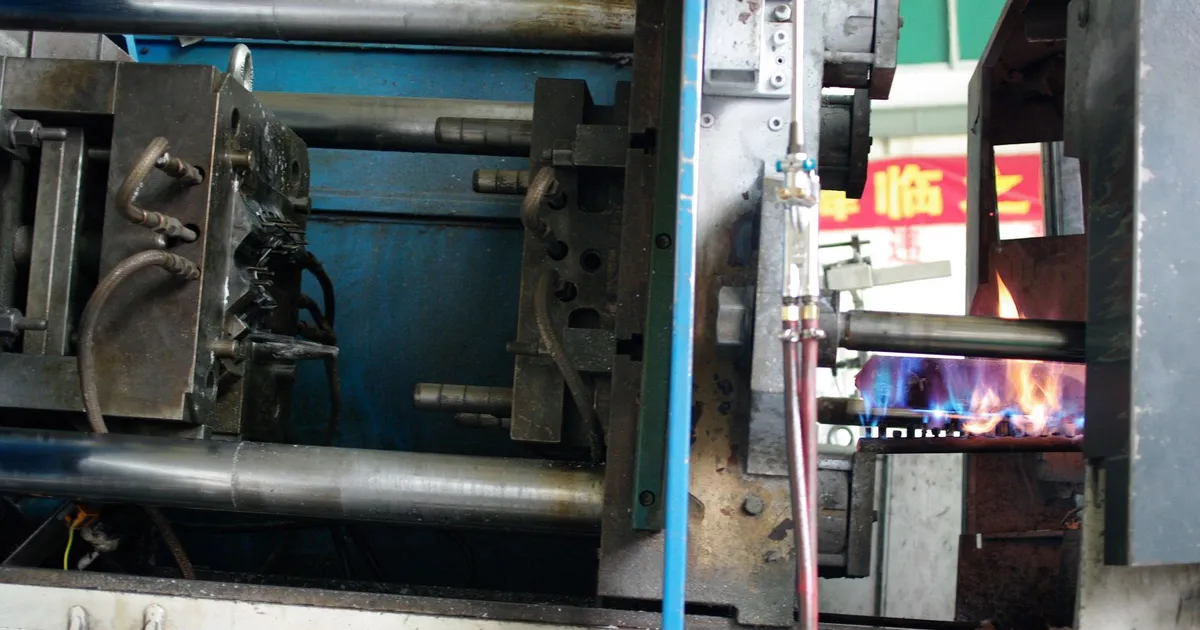
H11 and H13 are neighbours on the hot work steel chart. They look almost the same in a datasheet, they heat treat the same way and they are sometimes used for the same die. The differences are small in chemistry and real in service, and picking the wrong one rarely causes a disaster but can shorten tool life.
This note compares them where it matters for a buyer: composition, hardness, toughness, heat checking, machinability and cost.
The chemistry difference
Both are 5 percent chromium hot work steels with about 0.35 to 0.40 percent carbon and 1.2 to 1.5 percent molybdenum. The main differences:
| H11 | H13 | |
|---|---|---|
| Carbon | About 0.33 to 0.43% | About 0.32 to 0.45% |
| Chromium | About 4.75 to 5.5% | About 4.75 to 5.5% |
| Molybdenum | About 1.1 to 1.6% | About 1.1 to 1.75% |
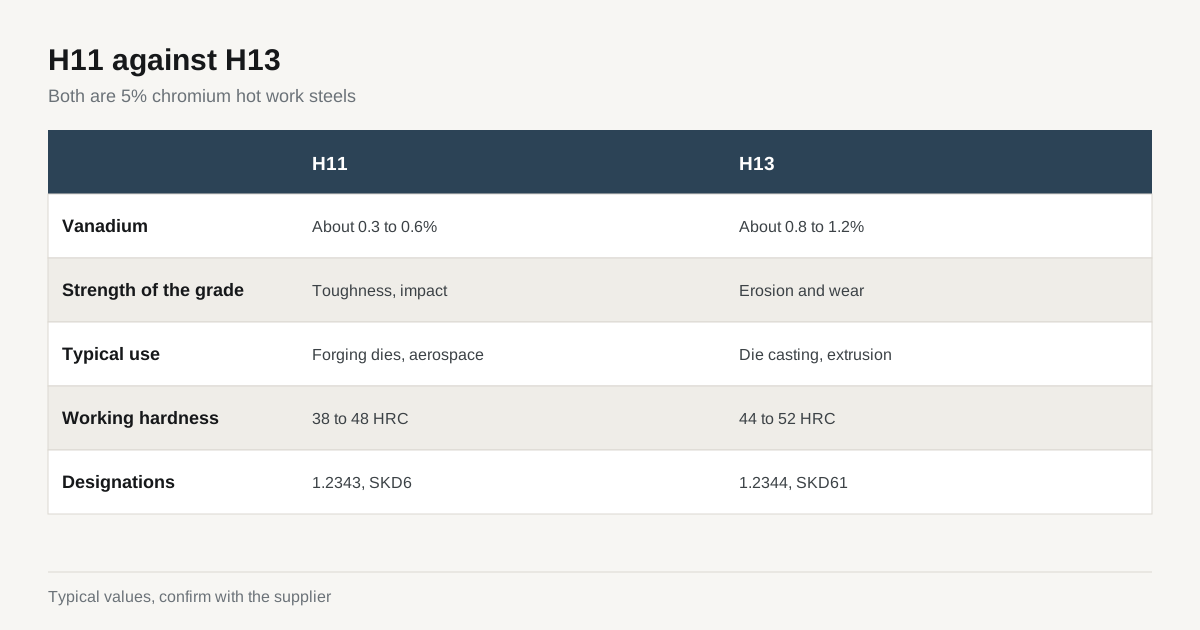
| Vanadium | About 0.3 to 0.6% | About 0.8 to 1.2% |
| Silicon | About 0.8 to 1.2% | About 0.8 to 1.2% |
| Other designations | 1.2343 (X38CrMoV5-1), SKD6 | 1.2344 (X40CrMoV5-1), SKD61 |
The principal difference is vanadium. H13 carries roughly double the vanadium of H11, which adds vanadium carbide, raises wear resistance and slightly improves hot strength. H11 has lower vanadium and generally better toughness. Do not treat these equivalents as exact. The standards allow ranges, and producers publish tighter windows, so always check the grade on the material certificate.
What each does best
H13 is the general purpose choice. The extra vanadium helps resist erosion from molten aluminium and wear from hot flowing metal. It is the most common die casting and extrusion tooling steel for good reason. It handles thermal cycling well, and with correct heat treatment it holds hardness through long runs.
H11 has better toughness and is slightly easier to machine and polish in some versions. It suits tooling where cracking is more likely than wear, such as forging dies with large impact, aircraft grade structural parts in the heat treated condition and some die holders. H11 is also a specification-driven grade: aerospace work calls for it by number, and the 1.2343 version is common in Europe for die casting inserts.
For a typical aluminium die casting insert, either steel works. The decision is usually made by the die maker’s habit, by availability of premium-grade stock or by an OEM specification.
Heat treatment
The two grades use the same cycle:
- Preheat in stages to about 650 and 850 °C to reduce thermal shock.
- Austenitise at about 1000 to 1040 °C, held for the section size.
- Quench in vacuum with gas pressure, or in oil or salt for smaller sections. Quench rate matters a great deal for toughness in H13, and slow quenching can drop impact values sharply.
- Temper at least twice, usually 540 to 620 °C, depending on target hardness.
Typical working hardness is 44 to 52 HRC for die casting inserts and 38 to 48 HRC for forging dies where toughness takes priority. Tempering at 540 to 560 °C stays clear of the temper embrittlement range, and for die casting a 46 to 48 HRC finish is common. Our comparison of D2 and H13 goes into the grades from the other side, and the page on heat treat allowance gives stock to leave for finishing.
Premium grades and quality levels
For critical hot work tooling, the quality of the bar matters more than the H11 or H13 label. Die casting premium grades follow standards such as NADCA #207, which sets limits on microstructure and cleanliness and specifies Charpy impact values and testing procedures. Ask whether the supplier can provide steel to that level. A premium H13 bar can outlast ordinary H13 by a wide margin, because it has fewer segregation bands and better isotropy.
Both grades benefit from electroslag remelt or similar processes for large, critical dies. If the die will see millions of shots, the extra cost of a premium bar is small compared with the price of an early failure.
Machinability and finishing
In the annealed state, both H11 and H13 machine well, at about 180 to 235 HB. They are among the easiest tool steels to cut, with machinability ratings often around 50 to 60 percent of the reference scale. Rough machining before heat treatment is straightforward, and finishing after hardening can be done by hard milling, EDM or grinding.
Where H11 and H13 differ in finishing is polishing. A heavy vanadium carbide population can leave very small differences in the polish quality, though both polish well when remelted. For a surface that needs a high polish, ask the producer which version is cleaner.
Nitriding is common on both, to reduce erosion and soldering in aluminium die casting. The cycle runs about 480 to 540 °C, so the steel must be tempered above it. Our note on nitriding and PVD after hard machining covers the sequence.
Heat checking and fatigue
Hot work dies fail by heat checking, a network of fine surface cracks caused by thermal cycling. Both grades suffer from it. Toughness slows crack growth, which is why a tougher, cleaner steel and a lower hardness often last longer than a harder, dirtier one. A die that is too hard cracks early, and one that is too soft erodes. The window of 44 to 48 HRC for aluminium die casting reflects that compromise.
Preheating the die before production, controlling spray cooling and stress relieving after heavy EDM or grinding all matter as much as the steel choice. A heat treater cannot fix a die that is cooled too hard in production.
Where each grade is used in practice
Die casters running aluminium, magnesium and zinc use H13 for cores, cavity inserts, ejector pins and shot sleeves. The steel stands up to molten metal at 650 to 700 °C for aluminium, and to the thermal cycle of each shot. Extrusion tooling for aluminium profiles is another large use, with nitrided H13 dies and mandrels common.
Forging dies work at lower speeds and higher impact. Here both H11 and H13 appear, at lower hardness than die casting inserts, often 40 to 46 HRC. Tooling for hot upset forging and closed die forging may use higher chromium-molybdenum-vanadium hot work grades or specialist steels, depending on the part and the metal being forged. A buyer who is not sure should ask the die maker for the failure history of the previous tool before picking the steel.
Cost and availability
H13 is the more widely stocked of the two. Distributors carry it in plate, round bar and block form in many sizes, and in premium and standard quality. H11 is stocked less often outside aerospace supply chains, so lead time and minimum quantities can differ. The price per kilogram is similar, because both are the same family of steel and the same producers make them.
A practical point: if a drawing calls for H11 and the shop only has H13, check whether the specification allows either. Substituting without agreement is a quality problem, and a quick message avoids it. Equally, if a drawing says H13 and the part sees large impact loads, asking whether H11 would be a better fit can save a failed tool.
Stress relief and finishing after EDM or grinding
Hot work dies are often finished by EDM, and EDM leaves a hard, brittle recast layer that is a starting point for heat checks. Standard practice for a die casting cavity is to remove most of the recast layer by polishing and to run a stress relief temper afterwards, typically 25 to 50 °C below the last tempering temperature. The same applies to heavy grinding passes. Our article on sinker EDM for hardened mold cavities describes the process, and the principles are the same for hot work steel.
A die that skips this step can show cracks in the first hundred shots. It is cheap insurance, and a drawing note such as “stress relieve after EDM, remove recast on cavity faces” tells the shop it is expected.
What to put on the drawing
- Exact grade (H11, H13, 1.2343, 1.2344) or a statement that either is acceptable
- Quality level, such as NADCA #207 premium, and whether a certificate is required
- Hardness range and the test position
- Heat treatment route: vacuum quench, number of tempers and stress relief after EDM
- Surface treatment such as nitriding, with case depth
Checklist before you send the RFQ
- Application: die casting, forging or extrusion, and the alloy being cast or formed.
- Expected shot count or die life.
- Block size and any large cavity depth.
- Whether the grade is fixed or open to the better stocked option.
- Surface treatment and finish after treatment.
Send the drawing through the RFQ form and a written quote comes back within 24 business hours.