420 stainless mold steel: polishability, corrosion and hardness range
When a mold makes lenses, medical housings or parts from PVC and other corrosive resins, a standard P20 or H13 cavity is the wrong tool. The cavity must polish to a mirror and stay that way, and it must not rust between production runs. Martensitic 420 stainless mold steel is the usual answer.
This note explains what the grade is, how hard it can be made, what polish it takes and where the traps are in machining and heat treatment.
What 420 mold steel is
Standard AISI 420 is a martensitic stainless steel with about 12 to 14 percent chromium and 0.15 to 0.4 percent carbon, depending on the version. Mold steel variants are produced by electroslag or vacuum remelting to remove inclusions, which are the enemy of a mirror polish. Several producers sell proprietary 420 type grades with controlled chemistry and cleanliness, and datasheet details vary by producer.
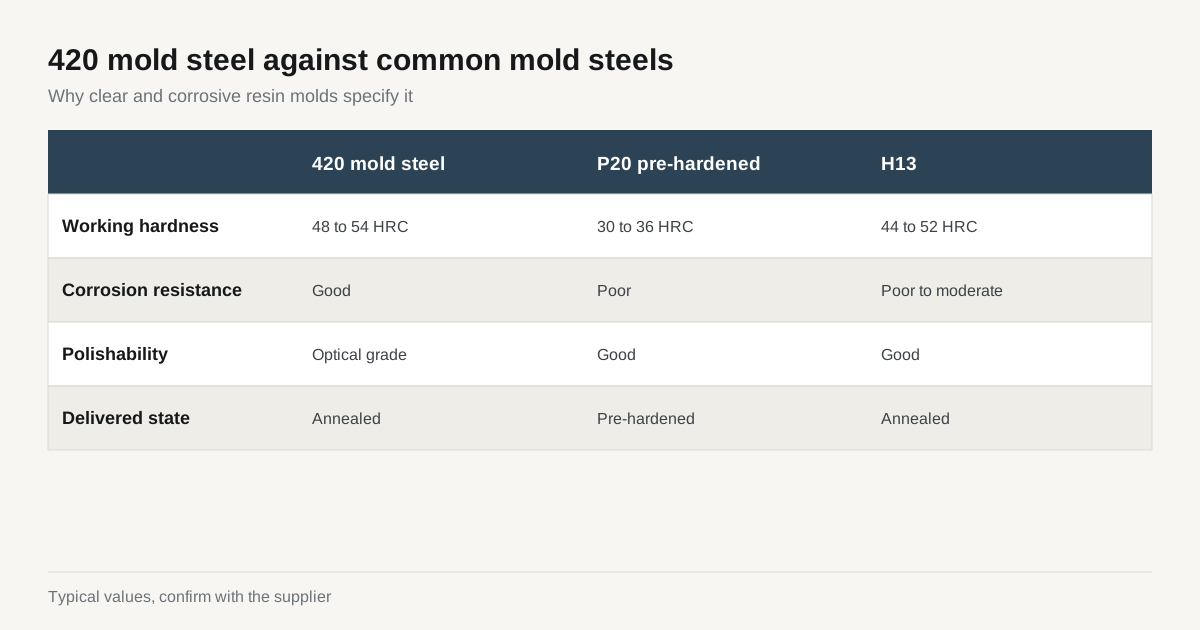
It hardens by quenching, like other tool steels, and is used at a working hardness of about 48 to 54 HRC. Above that it gains hardness but loses some corrosion resistance and toughness.
| 420 mold steel | P20 pre-hardened | H13 | |
|---|---|---|---|
| Typical working hardness | 48 to 54 HRC | 30 to 36 HRC | 44 to 52 HRC |
| Corrosion resistance | Good, 12 to 14% Cr | Poor, rusts | Poor to moderate |
| Polishability | Excellent, to optical grade | Good | Good |
| Delivered state | Annealed, hardened after machining | Pre-hardened | Annealed, hardened after machining |
| Typical use | Clear plastics, medical, corrosive resins | General molds | Die casting, hot work |
Polishability: why cleanliness matters
A mirror polish depends on the steel having no inclusions, no porosity and a fine, uniform microstructure. Oxide inclusions pull out during polishing and leave pits. Large carbides stand proud or fall out and leave a hazy surface. Remelted 420 grades keep inclusions low, so they polish to SPI A-1 or A-2 finish, which means a diamond finish suitable for optical parts.
Polish quality also depends on the hardness. A steel that is too soft (below about 45 HRC) can produce an orange peel effect in the finish. A steel that is hard enough, at 50 to 54 HRC, takes a stable, deep polish. A mold maker who needs optical quality wants the hardness at the top of the working range.
Retained austenite also matters. If heat treatment leaves too much, the polished surface can change over time and show distortion or ghosting. Controlled hardening and a proper temper, often with a sub-zero step, reduce it.
Corrosion: where it holds and where it does not
Twelve to fourteen percent chromium forms a passive film that resists humidity, water cooling and most common resins. It does not make the steel immune. The corrosion resistance depends on the chromium that is free in the matrix, not locked up in carbides. That is the reason the heat treatment matters:
- Temper at 200 to 300 °C keeps the chromium in solution and maximises corrosion resistance.
- Tempering around 450 to 550 °C lowers corrosion resistance and toughness (a known trap for 420 and 13 percent chromium steels) and should be avoided.
- A ground and polished surface resists corrosion better than a rough surface or one with a decarburised skin.
PVC and some flame retardant plastics release acidic gases that attack even stainless steel. For those resins, chrome plating on the cavity or a more corrosion resistant grade may be better. Ask the resin supplier for corrosion guidance, and do not rely on grade name alone.
Machining: soft and hard
The steel is supplied annealed at about 200 to 215 HB. In that state it machines like a medium alloy steel and is fairly easy. It is gummy compared with P20, so use sharp tools and good chip control.
After hardening, the options are the same as for other tool steels at 50 HRC:
- Hard milling with coated carbide or CBN on finishing passes
- Sinker EDM for deep ribs, followed by polish to remove the recast layer. Our note on sinker EDM for hardened mold cavities covers the details.
- Grinding for flat faces and parting lines
Common practice is to rough machine, heat treat, then finish the cavity hard and polish. Distortion in hardening is moderate, and stock for finishing is typically 0.3 to 0.5 mm per face on a cavity block.
Heat treatment points that decide the result
- Austenitise at about 1000 to 1050 °C and hold according to the producer curve. Overheating grows grain and reduces toughness.
- Quench in oil or vacuum with gas pressure. Slow quenching reduces hardness and corrosion resistance.
- Temper at 200 to 300 °C, twice, for the target hardness.
- Stress relieve after rough machining if the cavity is large and deep.
Document the heat treatment on the part record. A mold that cracks or rusts is often traced back to a tempering temperature that was off by only a few tens of degrees. Our guide to distortion and stress relief gives practical stock allowances.
Polishing practice and what the mold maker needs to know
Polishing a 420 cavity is a staged process. The cavity is finished to a uniform ground or milled surface, then worked with progressively finer stones and then diamond compounds. For optical quality, the last stages use diamond paste of 3 µm, 1 µm and sometimes 0.25 µm. Each stage removes the scratches of the one before, and skipping a stage leaves scratches that show in the finished part.
Two habits protect the result. Do not over-polish, because pushing the steel past the point where the scratches are gone leaves a wavy surface called orange peel, especially on softer steel. And keep the surface clean and free of grinding residues between stages. The polisher needs to know the steel grade and hardness, because 420 at 52 HRC behaves differently from P20 at 32 HRC.
Storage and care of stainless cavities
Even a stainless mold needs care. Chlorides from sweat and handling, cooling water that is not treated and cavities left wet in storage can all cause pitting on a polished face. Standard practice is to dry the mold after use, apply a rust preventive that does not leave residue on the cavity, and store it in a dry place. A stainless steel mold that is neglected can still rust, and a pitted polished face means a full repolish.
When 420 is not the right grade
The grade has limits. For very high wear on glass-filled resins, a harder, higher carbide steel is a better match, and for large molds that need through-hardening in thick sections, a more hardenable steel may be needed. For simple molds with no corrosion or optical demand, P20 at lower cost is sufficient. The grade table in our tool steel grades reference lists the main mold steels side by side for a first comparison.
Texture, photoetching and later modification
Many 420 molds also carry a surface texture, such as a light matte for cosmetic parts or a photoetched grain. Etching works on the polished surface and removes a small amount of steel, so texture depth and hardness need to be agreed up front. Welding repairs on hardened 420 are possible but demand preheat and a stress relief, and they rarely give a perfect polish across the weld. If the mold is likely to need engineering changes, mention it, so the cavity block is made with enough steel to allow for rework.
What to put on the drawing
- Exact grade or accepted equivalents, and the remelt requirement if optical polish is needed
- Hardness range, such as 50 to 54 HRC, and the test method
- Surface finish by SPI grade or Ra, per face
- Polish method restrictions, such as no heavy abrasive blasting on the polished face
- Material certificate with heat number
- Coating or plating if required on the cavity
Questions for the shop
- Which 420 grade and which producer do you buy, and is it remelted?
- How do you control tempering temperature, and do you record it per batch?
- Who polishes the cavity, and to what standard?
Checklist before you send the RFQ
- Resin to be moulded, since it decides corrosion needs.
- Polish level per face.
- Hardness window and any post-treatment such as plating.
- Cavity size and depth.
- Expected shots over the life of the mold.
Send the drawing through the RFQ form and a written quote comes back within 24 business hours.