Forming rolls for roll forming lines: grade, hardness and profile grinding
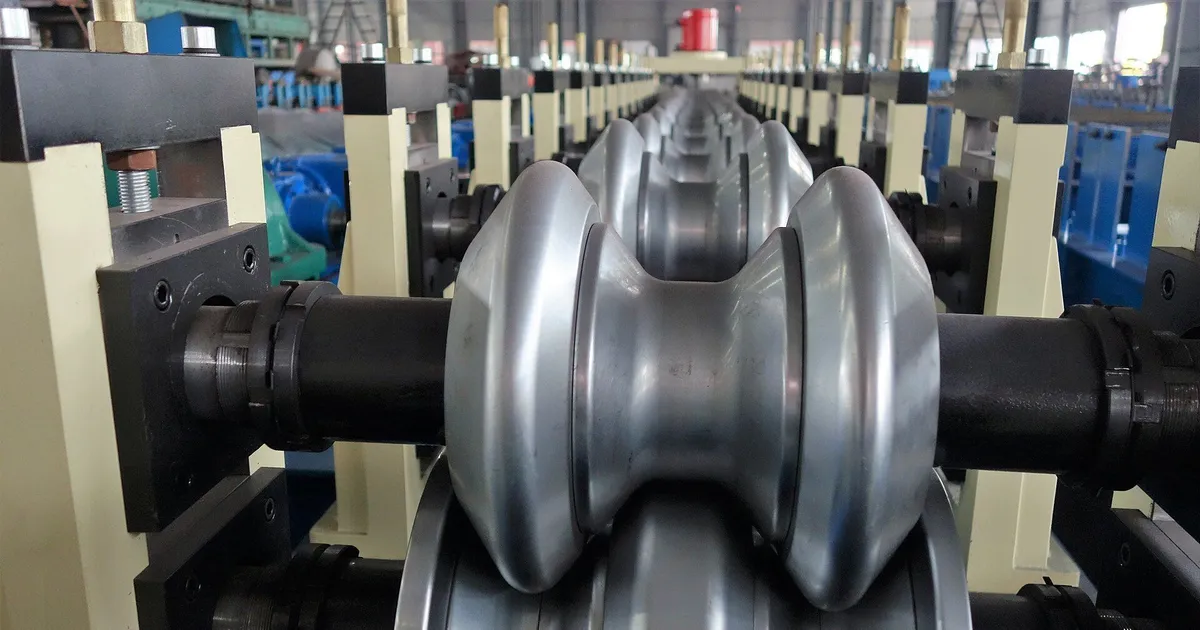
A roll forming line bends a flat strip into a channel, a tube or a complex profile by passing it through a series of paired rolls. Each station bends the strip a little further. The rolls decide the shape, the surface of the finished profile and the number of metres between roll changes, so they are worth specifying with care.
This note covers how the steel and hardness are chosen for the strip material, how the profile is finished and what a roll drawing needs to say.
What a roll set is
A roll set is made of one or more rolls on parallel shafts, usually a top and a bottom roll per station. Each roll is a disc or a cylinder with a profile around its circumference, a bore for the shaft and a keyway or other drive feature. A typical line has 8 to 30 stations. Rolls may be cut from solid bar or made as a stack of discs and spacers on a common shaft.
The roll takes three kinds of wear:
- Abrasion from the strip surface, especially on coated or scaled strip
- Galling where strip material sticks to the roll, often on stainless steel, aluminium and galvanised strip
- Compressive load at the bend radii, where the strip is squeezed
Choosing steel and hardness
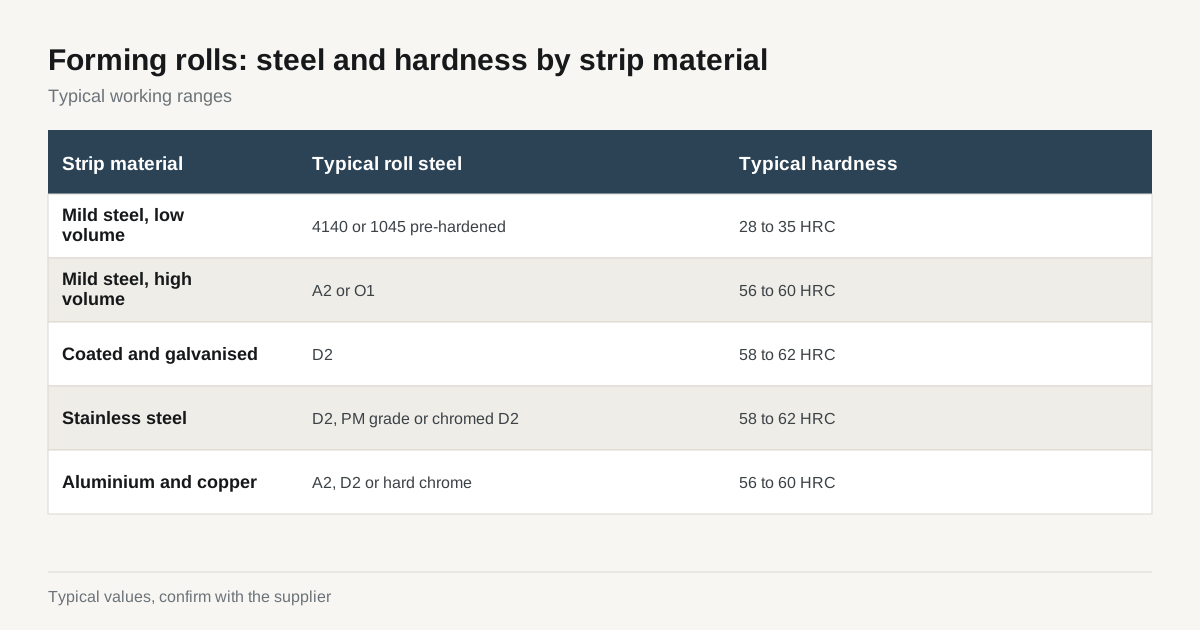
| Strip material | Typical roll steel | Typical hardness | Notes |
|---|---|---|---|
| Mild steel, low volume | 4140 or 1045, pre-hardened | 28 to 35 HRC | Cheap and easy to machine, lower wear life |
| Mild steel, medium to high volume | A2 or O1 | 56 to 60 HRC | Good wear life and good grinding |
| Coated and galvanised steel | D2 | 58 to 62 HRC | Wear resistance against zinc and coating abrasion |
| Stainless steel | D2, PM grade, or chromed D2 | 58 to 62 HRC | Galling resistance needs a smooth hard surface |
| High strength steel | D2, PM grade | 60 to 62 HRC | High contact stress needs hard surface |
| Aluminium and copper | A2, D2 or hard chrome plated | 56 to 60 HRC | Sticking and galling are the concern |
The hardness window is a compromise. Rolls at the top of the range last longer in abrasion but chip at the edges of profile features when a strip jams or doubles. Our note on pre-hardened and through-hardened tool steel describes the cost and distortion trade-off between the two routes, and the tool steel grades table lists the common options.
Making the profile
The sequence for a hardened roll:
- Turn the blank in the annealed state from bar or forging, leaving 0.3 to 0.5 mm on the bore, outside diameter, faces and profile.
- Cut the keyway and any drive holes, since they are hard to do after hardening.
- Stress relieve, then harden and temper. Rolls ovalise and grow slightly in hardening, so the allowance matters.
- Grind the bore to size, the reference for everything else, and grind the faces parallel to each other.
- Finish the profile by profile grinding with a form wheel, or hard turning with CBN on a lathe, working from the ground bore.
- Polish the working surface, then inspect with a profile projector, template or CMM.
Because all cutting references the bore, it is ground first and measured against the shaft fit. A bore tolerance of H6 or H7 with face runout of 0.01 mm is typical. Rolls run in matched pairs on a shaft, and any error in concentricity shows up as a ripple in the strip.
Profile tolerance and surface finish
Typical figures for a precision roll:
| Feature | Typical tolerance |
|---|---|
| Profile form | ±0.02 to ±0.05 mm against template |
| Roll diameter at the working radius | ±0.01 to ±0.02 mm |
| Concentricity of profile to bore | 0.01 to 0.02 mm TIR |
| Face parallelism | 0.01 mm |
| Surface finish on forming surface | Ra 0.4 µm, or Ra 0.1 to 0.2 µm for stainless and painted strip |
| Corner radii | As drawn, with tolerance ±0.05 mm |
Finish matters more on rolls than on most tooling. A scratch in a roll copies onto every metre of strip, and a rough surface on a pre-painted or stainless strip damages the surface. Ask for polish to the specified Ra and for the polish direction to run around the circumference, since the strip moves in that direction.
Hard turning versus grinding is a real choice here. A good CBN profile turn is fast and flexible, and grinding gives a finer finish and tighter form. Our article on hard turning against cylindrical grinding compares them for round parts, and the same trade-offs apply to profile rolls.
Surface treatments
Several treatments extend roll life or cut galling:
- Hard chrome plating, 10 to 25 µm, adds hardness and a low friction surface and is widely used on rolls for stainless and aluminium. It adds thickness, so the final size is set after plating.
- Nitriding raises surface hardness on nitridable steels without a coating, with limited growth.
- PVD coating such as TiN or CrN gives low friction and good wear resistance on D2 rolls.
- Polishing after treatment restores finish.
Sequence and allowances matter. Plating and coating add size to the profile, and polishing removes some of it. Our note on nitriding and PVD after hard machining lays out the order of operations.
Roll care and what goes wrong
Four problems account for most roll complaints. Strip wander and edge damage point to misaligned rolls and not to steel. Chatter marks across the strip point to runout and bore fit. Galling points to finish, coating or lack of lubricant. And profile wear that changes the section shape points to a roll that was too soft for the strip. Rolls can be reground a limited number of times, so ask the maker how much diameter can be removed before the profile is lost, and plan a regrind schedule.
Roll design details that affect machining
A few geometry details change the cost of a roll more than the steel does. Sharp internal radii in the profile need small grinding wheels or a form wheel dressed to a tight radius, and these wheels wear fast. A radius of 1 mm or more is far easier to hold than 0.3 mm. Deep, narrow grooves are hard to grind and hard to polish. Ask whether a small change in radius or groove width would still form the strip correctly, because the strip itself seldom needs a perfect sharp corner.
Discs and spacers on a common shaft are cheaper to make than solid rolls with many profiles, and they allow worn profile discs to be replaced individually. Solid rolls hold concentricity better and suit high-speed lines. The choice depends on the line design and the tolerance of the finished profile.
Matched sets and trial runs
Top and bottom rolls at each station work as a pair, so size and profile must match across the set. Shops that make full sets keep a common reference and measure every roll against the same template. For a new profile, ask whether a trial run is planned. Roll forming is often tuned with shims and small adjustments, and a roll set made to the drawing may need a fine correction after the first strip runs through. Agree up front who pays for any correction, and how much stock is left on the working surface to allow it.
Questions for the shop
- Do you grind profiles with a form wheel or hard turn them with CBN, and what finish does each give?
- How do you hold concentricity between the profile and the bore on a full set?
- What do you do to control ovality after hardening, and how much stock do you leave?
- Can you provide a template check or a profile report for each roll?
A shop that answers these in specific terms has made rolls before. A vague answer is a reason to ask for a sample roll first.
Typical lead time drivers
Roll sets take longer than their size suggests, because each roll passes through turning, heat treatment, bore grinding and profile finishing in sequence, and each step waits for the one before. A full line set of 20 stations can take several weeks. The steps that most often add delay are heat treatment batch scheduling, form wheel dressing for each different profile and final inspection. Sending drawings in station order and agreeing on partial deliveries, such as the first ten stations first, lets the line start trials while the rest of the set is finished.
What to put on the drawing
- Steel grade and hardness, and the strip material and thickness range
- Bore size, fit, keyway and runout limits
- Profile as a model and a 2D section with tolerances and radii
- Surface finish on the forming surface and its direction
- Surface treatment, and whether sizes are before or after it
- Regrind allowance, if the roll is to be reground
- Marking of station number and set, placed away from working surfaces
Checklist before you send the RFQ
- Profile drawing for every station, or the flower diagram, with strip thickness and material.
- Production volume and the tool life you expect.
- Shaft and bore details of the existing line.
- Surface finish and treatment needs.
- Number of roll sets and spares.
Send the drawing through the RFQ form and a written quote comes back within 24 business hours.